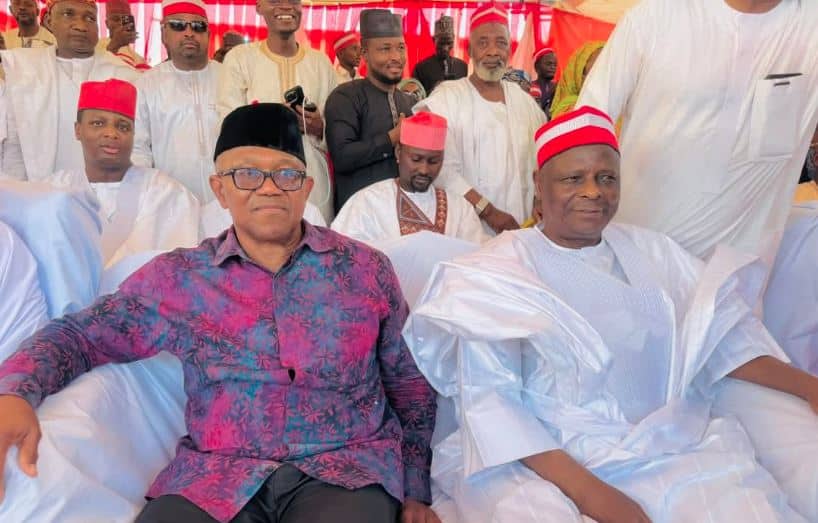

Elder statesman and PDP chieftain, Chief Mike Ahamba, has said a political arrangement that allows the presidency to return to the North in 2031 could boost Northern support for a possible Peter Obi and Rabiu Kwankwaso alliance in the 2027 election.
Ahamba, a Senior Advocate of Nigeria (SAN), made the remarks while reacting to the reported zoning proposal by the New Nigeria Democratic Congress (NDC), which plans to allocate the presidency to the South for one four-year term before rotating power back to the North.
According to him, such an agreement could become a strong political formula capable of attracting broad regional support and stabilising Nigeria’s political climate.
“Yes. It may make the North support Kwankwaso in 2027. I think it is quite favourable for them to support Obi and Kwankwaso,” Ahamba said.
He argued that if the North is assured of reclaiming power after four years, Northern voters may be more willing to support a Southern candidate like Peter Obi alongside Kwankwaso as running mate or political ally.
“After four years, they take back the power for another eight years. After eight years, it comes down to the South,” he stated.
Although Ahamba clarified that he is not personally an advocate of zoning or rotational presidency, he admitted that the arrangement has increasingly become an accepted political convention in Nigeria.
He explained that while the Constitution does not mandate rotation between regions, political parties have gradually embraced it as a stabilising principle to maintain balance and national peace.
“This is an unwritten law. It can become a convention which can maintain peace in a country,” he said.
The senior lawyer noted that any Southern candidate contesting under such an arrangement in 2027 should understand from the outset that the expectation would be to serve only one term before handing over to the North.
Ahamba also referenced President Bola Tinubu’s administration, noting that if Tinubu completes two terms, power would naturally shift back to the North under the prevailing political understanding between regions.
Reacting to concerns that the Nigerian Constitution permits a president to seek a second term, Ahamba insisted that moral and political agreements among parties should still be respected.
“One will expect that anyone running for presidency should be gentleman enough to follow the agreement,” he said.
He pointed to Peter Obi’s previous comments suggesting he would be willing to serve only one term if elected, saying such a position aligns with the proposed arrangement.
“Peter Obi, for example, says he’ll only be there for four years,” Ahamba added.
Despite backing the idea as a practical political compromise, the PDP chieftain warned that strict rotational politics could sometimes produce unsuitable leaders simply because it is the turn of a particular region.
Still, he acknowledged that a large section of Nigerians now support zoning and rotational presidency, saying democracy requires adapting to the wishes of the majority.
The comments come amid growing discussions around coalition politics, opposition alliances, and possible power-sharing formulas ahead of the 2027 presidential election.