
27-Year-Old Nigerian With BSc, MSc and PhD Sparks Debate After Protesting Unemployment in Abuja
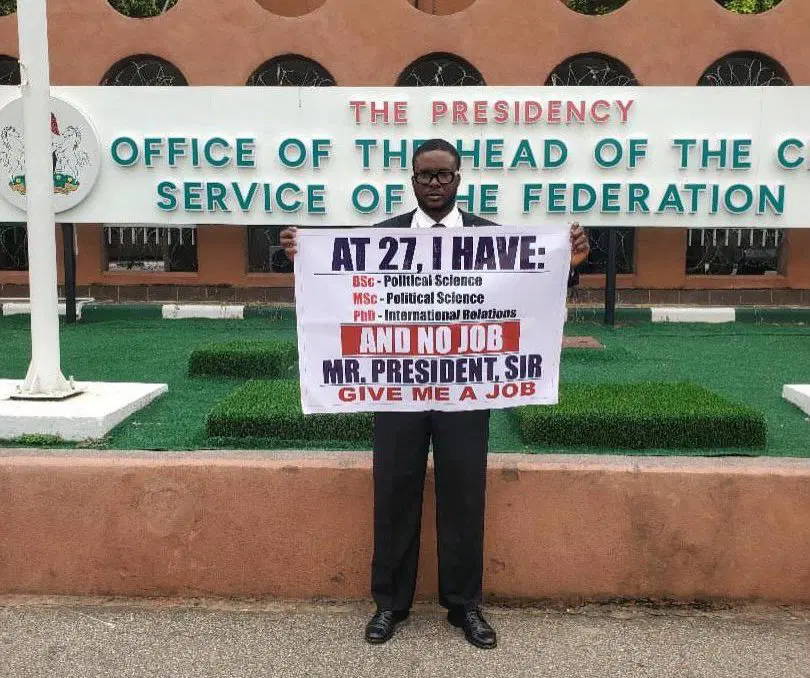
A 27-year-old Nigerian scholar, Ayomide Alokun, has triggered widespread reactions online after publicly protesting his unemployment despite holding multiple academic qualifications.
Alokun was seen in Abuja carrying a placard stating that he possesses a Bachelor’s degree and Master’s degree in Political Science, as well as a PhD in International Relations, yet remains without a job.
The protest quickly gained attention on social media, reigniting debates about unemployment, underemployment, and the growing frustration among highly educated Nigerian youths struggling to secure opportunities.
In the viral video, Alokun also highlighted his service during the COVID-19 pandemic, noting that he received national recognition while serving as a corps member for distributing palliatives to vulnerable communities.
While many Nigerians sympathised with his situation, others questioned why someone with advanced academic qualifications was still depending on government employment rather than pursuing entrepreneurship or private-sector opportunities.
One X user, identified as @Reels_Xtra, criticised the scholar’s approach, arguing that academic degrees alone are no longer enough in today’s economy.
“How do you have a PhD degree without having skills and knowledge to create opportunity?” the user wrote.
Another user, @Jaheem_Official, said graduates should focus more on self-development and building practical skills rather than waiting for government jobs.
“How is he still waiting for a job from the government? The system may be bad, but why spend years studying only to depend on government employment?” the post read.
Others echoed similar views, insisting that Nigerian youths must embrace vocational skills, entrepreneurship, and digital opportunities in response to the country’s shrinking formal job market.
However, many social media users blamed the country’s worsening economic conditions and the limited availability of jobs despite increasing numbers of graduates entering the labour market every year.
“This country is finished,” one user wrote. “Spending years in school and still having no assured job is terrible.”
Another commenter expressed concern about the pressure facing young Nigerians as universities and tertiary institutions continue producing graduates without corresponding employment opportunities.
The debate has once again raised questions about the value of higher education in Nigeria, the relevance of academic qualifications in the modern economy, and the widening gap between university training and labour market realities.
As reactions continue online, Alokun’s protest has become a symbol of the frustration many educated young Nigerians feel amid rising unemployment, economic hardship, and uncertainty about the future.