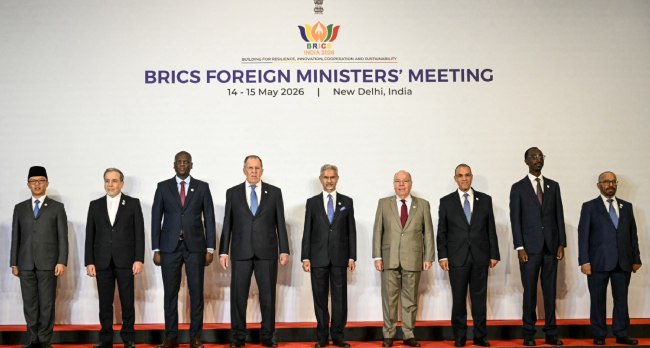

Global tensions over the Iran conflict and rising energy insecurity dominated discussions as BRICS foreign ministers gathered in New Delhi, with India warning that the world is facing “considerable flux” driven by war, economic instability and fractured global trade.
The two-day meeting brought together top diplomats from the expanded BRICS bloc, including Iran and Russia, at a time when geopolitical divisions and disruptions in energy supply chains are reshaping global markets.
Opening the talks, India’s Foreign Minister Subrahmanyam Jaishankar said international relations were going through a period of major uncertainty, with conflicts and economic pressures influencing nearly every region of the world.
He noted that emerging economies were increasingly looking to BRICS to provide stability and a more constructive role in global governance, particularly as challenges mount in areas such as energy, food security, fertilisers, health systems and access to finance.
Among the key attendees were Iran’s Foreign Minister Abbas Araghchi and Russia’s Foreign Minister Sergei Lavrov, reflecting the bloc’s widening membership and its growing political weight amid global realignments.
Energy security emerged as a central concern, with disruptions in Gulf shipping routes and the Strait of Hormuz contributing to volatility in global oil and gas prices. The instability has placed additional pressure on import-dependent economies such as India.
India, the world’s third-largest oil importer, sources nearly half of its crude through the Strait of Hormuz, a critical route that has faced repeated disruption since the outbreak of war involving Iran earlier this year.
In response to supply risks, New Delhi has increasingly diversified its energy sources, leaning heavily on Russian crude while also strengthening ties with other long-standing suppliers to cushion the impact of market instability.
Jaishankar also held bilateral discussions with Russia’s Sergei Lavrov, describing political cooperation within BRICS as increasingly important in a “volatile global environment” shaped by shifting alliances and economic uncertainty.
He added that discussions among member states also covered trade, investment, energy cooperation and connectivity, as countries seek to protect their economies from ongoing global shocks.
Originally formed in 2009 by Brazil, Russia, India, China and South Africa, BRICS has expanded significantly in recent years to include Egypt, Ethiopia, Iran, Saudi Arabia, Indonesia and the United Arab Emirates, broadening its geopolitical reach.
However, internal divisions remain, particularly over the Middle East conflict and differing relations with Western powers, raising uncertainty over whether the meeting will conclude with a joint statement.
India has confirmed that a leaders’ summit will follow later in the year, with Prime Minister Narendra Modi expected to host member states as the bloc continues to position itself as a counterweight to Western-led global institutions.