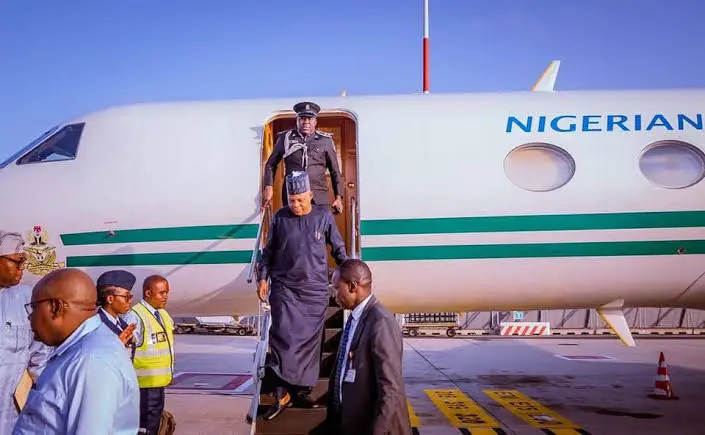

Vice President Kashim Shettima arrived in London in the early hours of Monday, July 14, 2025, to personally oversee the return of former President Muhammadu Buhari’s remains to Nigeria. Buhari died on Sunday after a prolonged illness, bringing an end to a defining era in Nigeria’s political history.
Shettima departed Nigeria around midnight on Sunday, according to top presidential sources, and was received at the London hospital by Nigeria’s Minister of Foreign Affairs, Ambassador Yusuff Tuggar. Also present to welcome the Vice President were Borno State Governor Babagana Zulum and the Chief of Staff to the President, Femi Gbajabiamila.
This marks the final diplomatic gesture to honour the late statesman who governed Nigeria both as a military head of state from 1983 to 1985 and later as a democratically elected president from 2015 to 2023. His body is scheduled to arrive in Nigeria today for immediate burial in Daura, Katsina State, in accordance with Islamic rites.
Buhari’s health had long been a subject of speculation, with several hospital visits abroad during his presidency. Although the family has not disclosed the official cause of death, reports suggest he had been battling complications related to blood cancer and leukemia. He was 82.
A high-powered federal delegation awaits the body in Daura, where security has been intensified in preparation for the burial. Dignitaries, religious leaders, and top military brass are expected to join President Bola Tinubu in the solemn ceremony to lay Buhari to rest in his ancestral homeland.
As tributes continue to pour in from across the globe, Vice President Shettima’s presence in London underscores the national weight of the moment. Government flags remain at half-mast as part of a seven-day mourning period declared by President Tinubu. A special Federal Executive Council (FEC) session in honour of the late president is also scheduled for Tuesday.
Nigerians at home and abroad are holding vigils and prayers in memory of Buhari’s contributions — a man whose life story mirrored the turbulence and transformation of the Nigerian state over five decades.