
When the Rains Betray the Farmers: Climate Change and the Experience of Arable Crop Farmers in UAES Host Communities
When Mrs Akpelu Celin cultivated cassava in the current planting season, she looked forward to months of hard work ending in a rewarding harvest. Like many farmers in the host communities of the University of Agriculture and Environmental Sciences (UAES), Umuagwo, Imo State, she had invested her savings in land preparation, labour and planting materials, hoping for a productive season.
Then the rains came. Not the gentle showers farmers depend on, but relentless downpours that turned her farmland into a floodplain. Within days, much of her newly planted cassava had been submerged, wiping out weeks of effort and investment.
Recounting her experience, she said: “The experience was very painful. After planting, heavy rainfall caused serious flooding on my farm. Many of the cassava stems I planted were submerged and destroyed. I lost money spent on land preparation, labour and planting materials.
“I was expecting a good harvest that would help me take care of my family, but the flood changed everything. Climate change is making farming more difficult because we no longer know what to expect from the weather.”
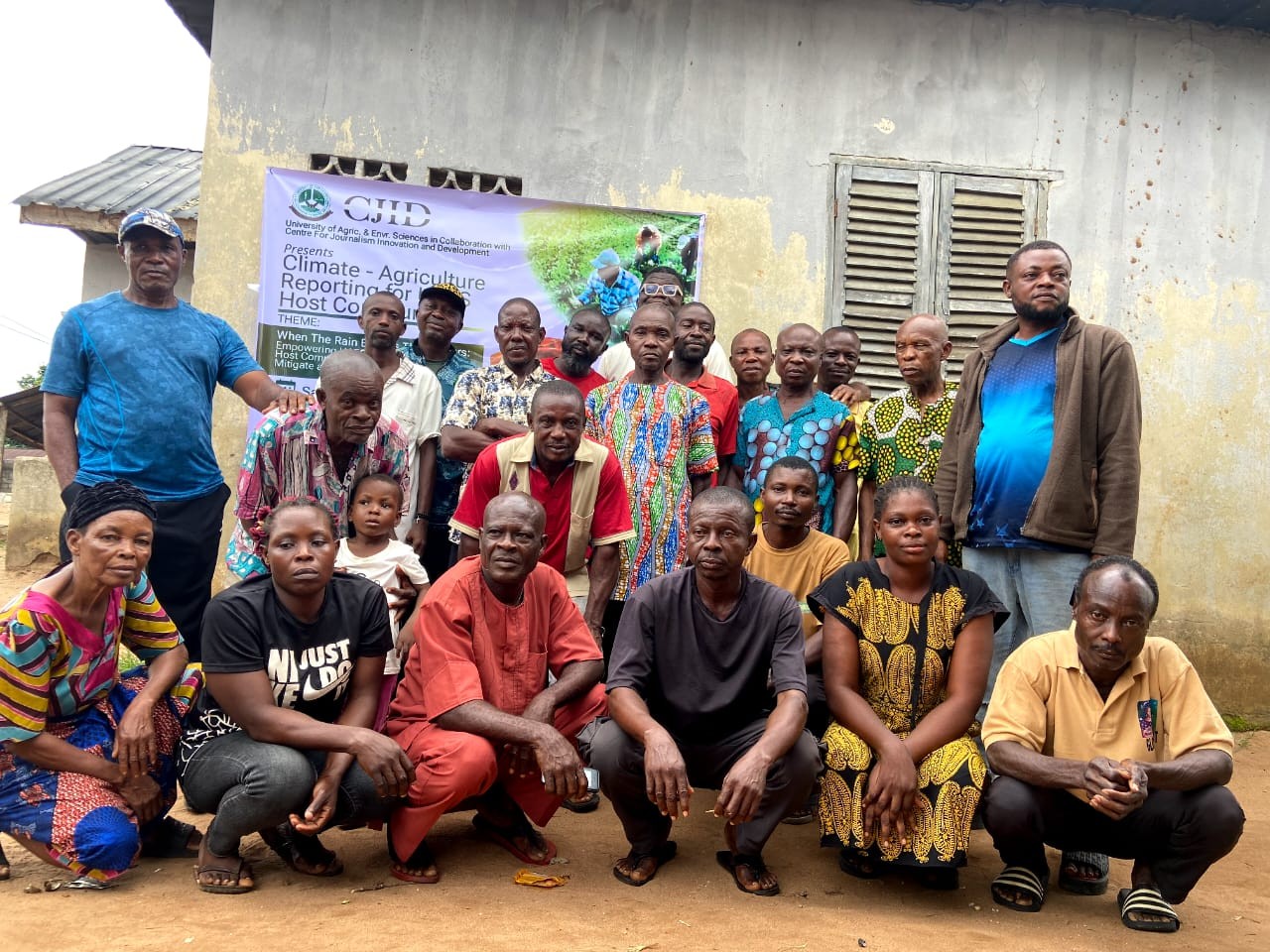
Celin’s experience was one of several shared during a Climate-Agriculture Reporting engagement organised with the support of the Centre for Journalism Innovation and Development (CJID), Abuja, in collaboration with the University of Agriculture and Environmental Sciences (UAES), Umuagwo.
The engagement brought together farmers from the University’s host communities and was led by Dr Esiobu Nnaemeka Success, a lecturer at UAES, with the approval and support of the Vice-Chancellor, Prof. Chiedozie Christopher Eze.
Across Umuagwo, Umuapu and Mgbirichi host communities, farmers described how unpredictable weather has disrupted farming activities. While some battled destructive floods, others struggled with prolonged dry spells, high temperatures, pest attacks and declining harvests.
For these farmers, climate change is no longer an abstract concept. It is measured in flooded fields, failed crops, rising production costs and shrinking incomes.
Among those who shared their experiences was Mrs Agugwo Chioma, a cucumber farmer, who recounted how excessive rainfall destroyed much of her crop.
“The excessive rainfall and flooding affected my cucumber farm badly,” she said. “The water remained on the farm for several days and damaged many of the plants. Some of the crops died while others were attacked by diseases because of the wet conditions.
“The harvest was far below what I expected. As farmers, we depend on our farms for income, and when floods destroy our crops, our families suffer the consequences.”
For Mr Calistus Paul, a banana and plantain farmer, the challenge came from the opposite direction.
“While some farmers are struggling with too much rainfall, my challenge was the prolonged dry spell during the dry season,” he said.
“The rains stopped when the banana and plantain plants needed moisture the most. The plants became stressed, growth was poor and the yield reduced significantly. Because of the low harvest, my income dropped and it became difficult to meet business and family responsibilities. These changing weather conditions are affecting our livelihoods and making farming increasingly uncertain.”
As farmers exchanged experiences, a common concern emerged: weather patterns that once guided planting decisions have become increasingly unreliable.
The meeting, however, went beyond sharing experiences. Participants discussed practical ways of responding to climate-related challenges.
Farmers, researchers and development practitioners exchanged ideas on improved weather information, climate-smart farming practices, better drainage systems, crop diversification, improved crop varieties and stronger agricultural extension services.
Cassava and yam farmer Mr Osundu Anudokum said the programme had provided practical knowledge that could help him manage the effects of irregular rainfall on his farm.
He said the farming techniques and climate adaptation practices discussed during the engagement could help him make better decisions during periods of little or no rainfall and improve his chances of achieving better harvests.
Mrs Ihenatu Priscly also described the programme as timely and welcomed the decision to bring the training directly to farmers in the host communities.
She said the knowledge acquired had renewed her confidence ahead of the next planting season and expressed hope that applying the recommended practices would result in better harvests and improved food security for her household.
Offering an expert perspective, the Acting Dean of the Faculty of Agriculture, UAES, Dr Chizoma Osuagwu, said building resilience among farmers requires continuous access to knowledge, innovation and extension support.
She noted that climate change is redefining agricultural production across Nigeria, stressing that farmers must embrace climate-smart agricultural practices, improved crop management techniques and timely weather information to reduce production risks and sustain food production.
Dr Osuagwu added that partnerships involving universities, government agencies, development organisations and local communities remain important for translating research into practical solutions for smallholder farmers.
Agricultural extension agent Mrs Nneka Stella said changing weather conditions have made it necessary for farmers to rethink some traditional farming practices and embrace methods that improve resilience.
She explained that losses experienced by farmers are linked not only to changing weather patterns but also to limited access to timely agricultural information and extension services.
According to her, regular farmer training, reliable weather forecasts and climate-smart agricultural practices can help reduce production risks and improve farm performance.
Nneka urged farmers to apply the knowledge gained during the engagement by adopting improved planting methods, practising crop diversification, conserving soil moisture during dry periods and responding promptly to weather advisories.
“The real impact of programmes like this lies in what farmers do after the training,” she said. “When the knowledge shared here is put into practice, farmers will be better prepared for extreme weather conditions, achieve more stable yields, improve household incomes and strengthen food security within their communities.”
The Vice-Chancellor, Prof. Chiedozie Christopher Eze, welcomed the collaboration between the University and CJID, saying it aligned with the University’s community engagement and sustainable development objectives.
He said UAES would continue to support agricultural and environmental development in its host communities through research, innovation, training and the dissemination of modern agricultural technologies.
According to him, providing farmers with practical knowledge and evidence-based innovations can improve productivity, strengthen rural livelihoods and help farming communities respond to changing environmental conditions.
Speaking on behalf of the traditional institutions, the Head of the Council of Chiefs, Chief Eze Charles Ezeokwubudu, thanked UAES and CJID for bringing the programme to the communities.
“We are grateful that our community farmers have been given the opportunity to speak about the challenges they face as a result of climate change,” he said. “We look forward to more collaborations and programmes that will improve agriculture, strengthen livelihoods and promote sustainable development in our communities.”
As the programme ended, farmers remained in small groups, discussing what they had learnt and how they intended to apply it during the next planting season.
For many participants, the engagement provided an opportunity to learn from experts, exchange experiences with fellow farmers and identify practical steps for coping with increasingly unpredictable weather.
The experiences shared by farmers in Umuagwo, Umuapu and Mgbirichi show that changing weather patterns are already affecting farming decisions, harvests and household incomes. Improved agricultural information, adaptation practices and sustained support will be important as these communities respond to those challenges.
This report was produced with support from the Centre for Journalism Innovation and Development (CJID). The engagement was presented by Dr Esiobu Nnaemeka Success, lecturer at the University of Agriculture and Environmental Sciences (UAES), Umuagwo, Imo State.