
Nigeria Ranks 4th in Global Terrorism Index 2026 as Attacks Surge Nationwide
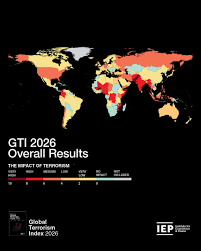
Nigeria has been ranked the fourth most terrorised country in the world in the Global Terrorism Index 2026, released by the Institute for Economics & Peace shortly after President Bola Ahmed Tinubu returned from an official visit to the United Kingdom.
The report revealed that 750 Nigerians lost their lives to terrorism in 2025, representing a 46 per cent increase compared to the previous year. It also noted that terrorist incidents rose from 120 in 2024 to 171 in 2025, indicating a sharp escalation in violence across the country.
Globally, Pakistan, Burkina Faso and Niger occupy the top three positions, with Nigeria now ranking fourth, moving up from sixth place in 2024.
The report identified the North-East as the epicentre of extremist violence, largely driven by groups such as Boko Haram and Islamic State West Africa Province. It also noted that insecurity has spread to the North-West, where bandit groups have intensified mass abductions and rural attacks, as well as the Middle Belt, where farmer-herder clashes continue to rise.
“In 2025, Nigeria rose two places in the index, reflecting the significant increase in terrorist activity in the country,” the report stated. “Deaths from terrorism have continued to rise, increasing by 46 per cent to 750 in 2025.”
According to the report, ISWAP and Boko Haram were responsible for about 80 per cent of terrorism-related deaths in Nigeria in 2025. Borno State accounted for 67 per cent of attacks and 72 per cent of deaths, highlighting the concentration of violence in the North-East.
Civilians remain the most affected, representing 67 per cent of fatalities, while military personnel accounted for 19 per cent.
The report has sparked political reactions, with opposition parties criticising the government’s handling of insecurity.
The Peoples Democratic Party described the findings as evidence of worsening insecurity under the Tinubu administration, urging a comprehensive approach to tackle the crisis.
Similarly, the African Democratic Congress noted a 43 per cent rise in attacks and warned that emerging groups such as Lakurawa signal deeper systemic issues.
A PDP spokesperson, Ini Ememobong, described terrorism as a “lucrative, trillion-naira economy” and called for a whole-of-society approach to restore peace.
Meanwhile, ADC’s Bolaji Abdullahi proposed a three-point strategy to address insecurity, including improved intelligence coordination, decentralised policing, and a shift toward intelligence-driven security operations.
Both parties stressed that safeguarding lives and property remains a core responsibility of the government and called for stronger security measures to curb the rising wave of violence.
The GTI 2026 report underscores Nigeria’s ongoing security challenges as the country continues efforts to restore stability in its most affected regions.