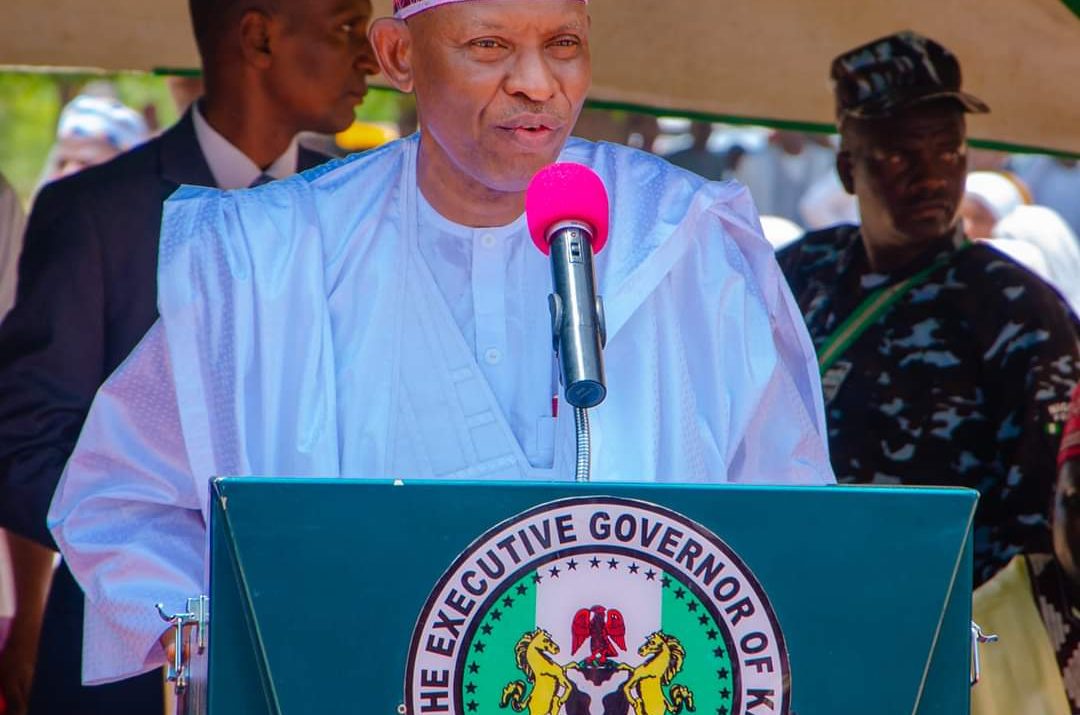

Governor Abba Kabir Yusuf’s defection to the All Progressives Congress (APC) has reopened deep political fault lines in Kano State, injecting new uncertainty into the long-running emirship crisis that has left the ancient throne contested by two rival monarchs. The key question now confronting Kano is whether the governor’s political realignment will finally calm the storm—or push the crisis into a more complex and unpredictable phase.
For almost two years, Kano has been locked in an extraordinary royal impasse. Emir Muhammadu Sanusi II occupies the historic Gidan Rumfa Palace, while Aminu Ado Bayero, the 15th Emir of Kano, continues to hold court at the Nassarawa mini-palace. Both men command loyalty from powerful political and institutional blocs, turning a traditional dispute into a deeply political struggle.
The crisis traces its roots to March 2020, when former governor Abdullahi Umar Ganduje removed Sanusi from the throne, accusing him of insubordination. Aminu Ado Bayero was swiftly installed as his successor. At the time, critics argued that the decision was driven less by tradition and more by politics, pointing to Sanusi’s perceived closeness to Senator Rabiu Musa Kwankwaso, Ganduje’s long-time rival.
The pendulum swung again in May 2024. Governor Yusuf’s NNPP-led administration repealed the 2019 emirate law, dismantled the five emirates created under it, and restored a single-emir structure. Sanusi was reinstated as Emir of Kano, a move that immediately sparked fresh legal battles, with Bayero challenging his removal in court.
Yusuf’s recent defection to the APC has dramatically altered the political equation. By joining the ruling party, the governor now finds himself aligned with Ganduje and Deputy Senate President Barau Jibrin—figures widely regarded as sympathetic to Bayero’s camp. The move also marked a clear rupture with Kwankwaso, Yusuf’s former political benefactor and a key backer of Sanusi’s return to the throne.
The shift has fuelled speculation that the emirship dispute could be revisited as part of internal reconciliation within the APC. That speculation gained momentum after Kano’s Commissioner for Information and Internal Affairs, Ibrahim Abdullahi Waiya, hinted at a possible political solution.
“Now we will sit down and resolve such problems calmly,” Waiya said during a radio programme. “There will be discussions; where apologies are needed, they will be offered, and where forgiveness is required, it will be granted. In some cases, someone may be asked to make sacrifices for the sake of peace.”
His remarks were widely interpreted as a signal that dialogue—rather than prolonged court battles—might be back on the table.
The governor, however, was quick to shut down claims that Sanusi’s position was under threat. Speaking through his spokesman, Sanusi Bature, Yusuf insisted there was no plan to remove the emir.
“There is no plan to replace Emir Sanusi on the throne of Kano,” he said, stressing that Sanusi’s reinstatement followed the repeal of the emirates law and that no further amendments were being considered. “Emir Sanusi remains the Emir of Kano. This defection to the APC will not change the status quo.”
Despite these assurances, the Bayero camp has firmly rejected any suggestion of negotiation. Sarkin Dawakin Babba, Aminu Babban Dan Agundi, who filed the legal challenge against the Kano State Government, said the matter rests solely with the judiciary.
“There is no negotiation that can lead to the removal of Emir Aminu Ado Bayero,” he said. “The case is before the courts, and only the Supreme Court has the authority to decide.”
Legal experts, however, argue that a settlement is still possible, even at this advanced stage. Barrister Umar Usman Dan Baito, a lecturer at Northwest University, Kano, noted that Nigerian law allows for alternative dispute resolution at any point in legal proceedings.
“Even if a case is before the Supreme Court, parties can still reach a settlement through ADR,” he explained. “Once the court adopts the agreement, the matter comes to an end.”
As politics, law and tradition continue to collide, the Kano emirship crisis remains delicately balanced. While Yusuf’s defection to the APC could offer a pathway to political consensus, it has also deepened mistrust and hardened positions on both sides. Whether this realignment will unlock a lasting resolution—or further entangle the dispute—now depends on how dialogue, judicial processes and traditional reconciliation unfold in the weeks ahead.