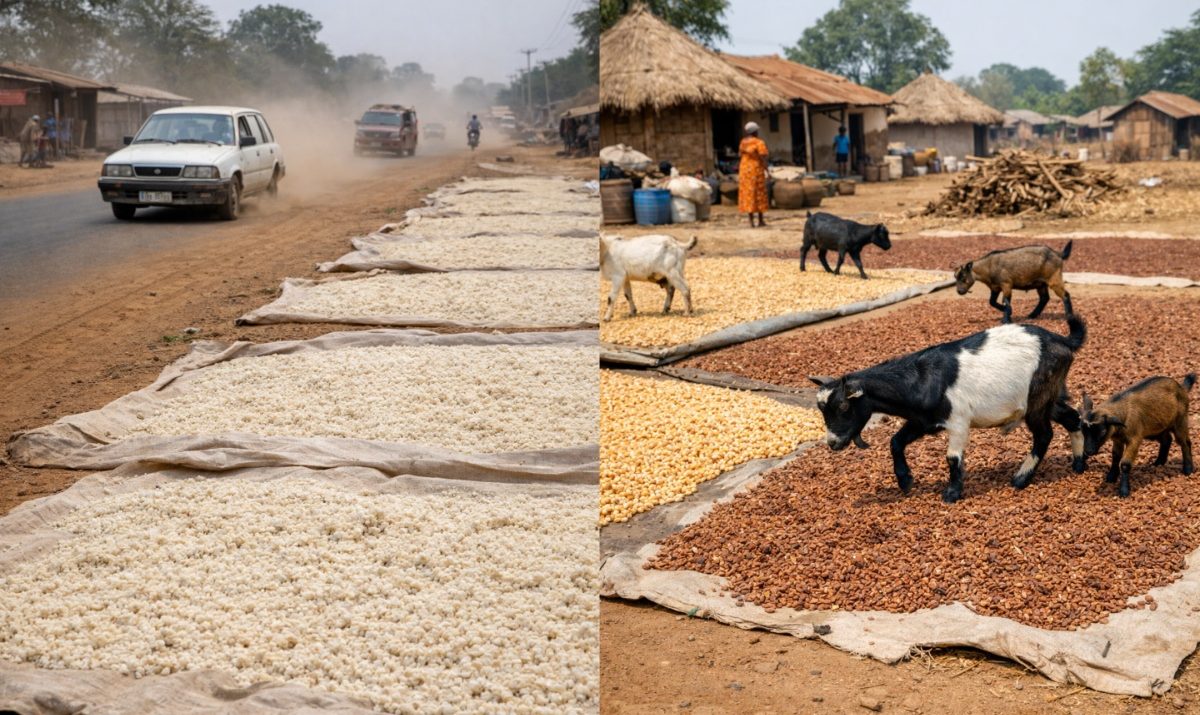

Across Nigeria’s highways and rural roads, piles of cassava, maize, rice, beans, pepper and melon seeds lie exposed under the sun — a familiar sight many see as harmless tradition. But health experts say this widespread practice is quietly turning the nation’s food supply into a breeding ground for disease.
From Ogun, Ondo and Oyo in the South-West to Benue, Kogi and Niger in the North-Central; from Imo, Enugu and Ebonyi in the South-East to Adamawa, Taraba and Yobe in the North-East, roadside drying cuts across regions, cultures and crops. Major transport corridors have become open-air drying floors where food meant for markets and kitchens absorbs dust, fumes and contaminants with every passing vehicle.
To many local processors, the roadside offers sunlight, space and convenience. To medical professionals, it is a contamination zone linking farms directly to hospital wards.
When Dust Becomes a Health Threat
At a cassava-processing community in the South-West, garri processor Mrs Adebisi explained the choice simply: “We don’t have space at home, and the sun is better near the road.”
Environmental health expert Sani John warns that the dust settling on food is far more dangerous than it appears. “Vehicle dust contains carbon, oil residues and sometimes heavy metals like lead. Once these enter food, washing later cannot remove everything,” he said, adding that gradual consumption can weaken immunity and damage vital organs over time.
Animals, Fungi and Invisible Killers
Goats and chickens freely walk over cassava, rice and beans spread on bare ground. Nutritionist Mrs Helen Okorie said such exposure introduces bacteria, worms and animal waste, turning food unsafe long before it reaches the kitchen.
She also warned about aflatoxins — poisonous substances produced by certain moulds common in poorly dried grains. “Aflatoxins are linked to liver cancer and poor growth in children. Rice and beans easily trap moisture, making them especially vulnerable,” she explained.
Stones in the Pot, Injuries in the Body
Beyond microbes, roadside drying also explains why stones and gravel often end up in rice and beans. Trader Mrs Fatima Kudu said many contaminants enter during drying, not farming. “Dust and stones are blown straight into the grains when vehicles pass,” she said.
Doctors say swallowed stones can cause intestinal injuries, while repeated exposure to contaminants leads to chronic stomach infections and food poisoning.
A Danger to Drivers Too
Commercial driver Mr Ibrahim Lawal said roadside drying also threatens road safety. “Food sometimes spills onto the road. Drivers swerve to avoid it, and accidents can happen,” he said.
Traders suffer financially as well. “When buyers see sand in garri, they reduce the price. We lose profit,” trader Mrs Funke Ade added.
Hospitals See the Consequences
Community health worker Mrs Desola Dotun in Osun State linked unsafe drying to rising food-borne illnesses. “Most people think sickness starts in the kitchen, but it starts from the drying ground,” she said, noting frequent cases of diarrhoea, worms and food poisoning.
Medical Director of Talakawa Pharmacy, Dr Fredrick Agbo, said roadside drying exposes food to exhaust fumes, insects, rodents and carcinogenic fungi. “People blame water or cooking, but the problem often begins during drying,” he said, urging safer alternatives such as raised platforms, tarps and solar dryers.
Government and Community Response
The Niger State Ministry of Health has also raised alarm. Director of Public Health Dr Ibrahim Idris warned that openly dried food is easily contaminated by dust, birds and rodents. He advised that sun-dried food must be properly cooked before consumption and covered with mesh if drying cannot be avoided.
Concerned by the risks, community leaders in Niger State have begun action. During a sensitisation programme in Mokwa, organised by the Federal Government, Niger State, IFAD and the Value Chain Development Programme (VCDP), farmers were urged to abandon roadside drying.
Health worker Nurse Leah Hassana Yisa warned that roadside drying could lead to food poisoning, cancer and intestinal problems. Local government chairmen pledged support, while religious leaders reinforced the message. “What you will not eat, don’t give to others,” said Chief Imam of Mokwa, Alhaji Musa Ibrahim.
VCDP official Mrs Elizabeth Yisa announced the provision of tarps and cement floors, prompting farmers to commit to change.
Support, Not Blame
Agricultural extension officer Mr Peter Danjuma said farmers are not careless but lack alternatives. “If government and NGOs provide drying platforms and training, roadside drying will reduce,” he said.
For many processors, the roadside remains a necessity, not a choice. “If we stop, our cassava will spoil. We need help, not punishment,” Mrs Adebisi admitted.
A National Public Health Test
Experts warn that contaminants introduced during roadside drying accumulate silently in the body, undermining immunity and child development while increasing long-term health risks.
The response in Niger State offers a template — education, infrastructure, regulation and community involvement. Without national commitment, however, Nigeria’s highways will remain an unofficial food-processing industry.
Until safer drying practices are widely supported and enforced, the dust of Nigerian roads will continue finding its way into daily meals — turning a survival strategy into a nationwide public health risk.