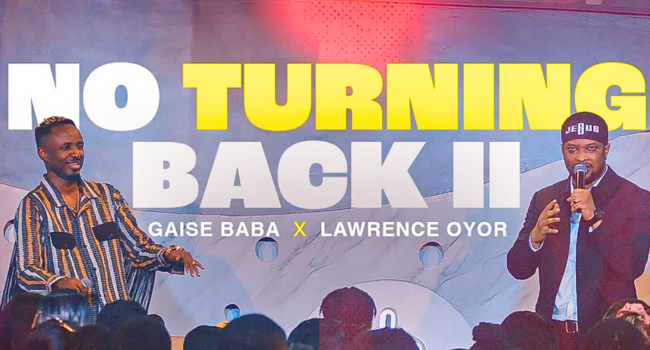

Gaise Baba’s worship anthem, No Turning Back II, featuring Pastor Lawrence Oyor, has emerged as Nigeria’s most-watched music video of 2025, according to YouTube statistics. The gospel hit, released on May 16, accumulated more than 41 million views, 397,000 likes, and over 22,000 comments, outperforming mainstream tracks across genres.
The video, celebrated for its spiritual depth and engaging visuals, has dominated both Christian and mainstream music spaces, resonating with audiences nationwide. Its popularity underscores the growing influence of gospel music in Nigeria’s entertainment landscape.
Gaise Baba expressed gratitude to his collaborators and the church congregation, describing the milestone as evidence of the song’s cultural and spiritual impact. “Big shout-out to Pastor Lawrence Oyor and that warrior congregation of David Generation Church. See what the Lord has done with our simple obedience. Of a truth, we shift the culture,” he commented on YouTube’s announcement post.
The song edged out several high-profile releases, including Shallipopi’s Laho, which secured the second spot, and Davido and Omah Lay’s collaboration With You, which placed third. Other notable entries in the top 10 included Olamide’s 99, Asake’s Why Love, and Wizkid’s Kese.
Beyond music, YouTube also recognised content creators, naming actress Omoni Oboli as Nigeria’s Top Creator Channel for 2025. She was followed by Ibrahim Yekini’s Itelediconstudio and filmmaker Uchenna Mbunabo’s Uchenna Mbunabo TV, highlighting the expanding digital content ecosystem in Nigeria.
The success of No Turning Back II reflects a trend where spiritually-driven content is achieving mainstream appeal, with audiences engaging with music that blends entertainment and worship. Analysts suggest this demonstrates the potential for gospel artists to reach mass audiences while maintaining religious authenticity.
With the year-end rankings, both music and content creation in Nigeria continue to demonstrate remarkable diversity, signalling a shift toward a broader appreciation of genres and digital creativity.