
Syria’s President Ahmed Al-Sharaa has completed one of the most remarkable political transformations in modern history, capping his rise from jihadist fighter to international statesman with a historic visit to the White House.
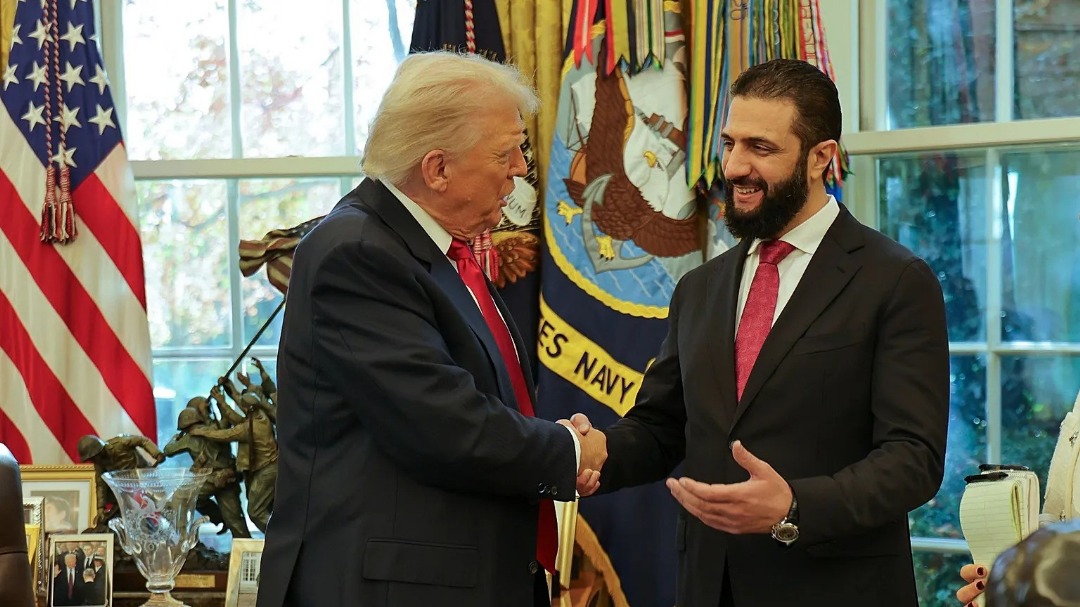
Al-Sharaa met with US President Donald Trump on Monday — marking the first time a Syrian leader has ever visited the White House. The meeting, seen as both symbolic and strategic, underscores Washington’s shifting stance toward Damascus and Al-Sharaa’s relentless effort to rebrand Syria on the global stage.
Trump praised his guest during their joint appearance in the Oval Office, calling him “a very strong leader” and “a tough guy from a very tough place.”
“I like him. I get along with him,” Trump told reporters. “We’ll do everything we can to make Syria successful.”
The visit follows Trump’s earlier decision to ease some of the crippling US sanctions imposed on Syria, a nation long isolated under the rule of the Assad family. On Monday, the White House extended a partial pause on most sanctions for another 180 days, though the most severe restrictions remain in place pending congressional approval.
Al-Sharaa, 43, seized power in January after toppling the Assad regime — ending five decades of autocratic rule and a brutal civil war that devastated the country. His government now seeks to rebuild a shattered economy and pivot Syria’s foreign policy away from dependency on Russia and Iran.
The Syrian leader has embarked on a whirlwind diplomatic tour, visiting 20 countries in less than a year, and now looks to secure a complete lifting of US sanctions and broader Western recognition. His trip to Washington — his second to the US following his UN General Assembly appearance in September — is by far his most high-profile engagement yet.
Once a jihadist insurgent who fought American forces in Iraq, Al-Sharaa’s journey to the White House represents a stunning reversal. Captured and later released, he returned to Syria in 2011, where he formed an Al-Qaeda-aligned militia to battle the Assad regime before eventually turning against extremism.
Trump acknowledged that turbulent past, remarking, “We’ve all had rough pasts, but he has had a rough past. And I think, frankly, if you didn’t have a rough past, you wouldn’t have a chance.”
Since taking power, Al-Sharaa has pursued what analysts describe as an ambitious campaign of “diplomatic redemption.” His administration has announced plans for Syria to join the Global Coalition to Defeat ISIS — aligning formally with the US and its allies in counterterrorism efforts.
A senior Trump administration official said the visit focused on “counterterrorism cooperation, economic development, and advancing regional peace and security,” adding that Syria’s partnership in combating ISIS marks “a new era of pragmatic engagement.”
Despite his westward shift, Al-Sharaa has been careful not to alienate Russia, which still maintains a strategic naval base in Tartus. During a visit to Moscow last month, he met President Vladimir Putin and emphasized that Syria “cannot afford conflict with Russia.”
“Engaging in a conflict with Russia right now would be too costly,” he told CBS’s 60 Minutes in October.
Analysts say Al-Sharaa’s diplomacy mirrors a new foreign policy trend among developing nations — balancing relations between competing powers rather than choosing sides.
Natasha Hall, a senior associate at the Center for Strategic and International Studies, described his approach as “non-alignment in a polarized world.”
“He’s rebuilding Syria’s image globally without burning bridges with old allies,” Hall said.
Washington’s bet on Al-Sharaa remains risky, experts warn. “The US is taking a large gamble on Syria,” said Joshua Landis, director of the Center for Middle East Studies at the University of Oklahoma. “But Lebanon is a failed state and Iraq is deeply penetrated by Iranian militias — Washington has few alternatives.”
As Al-Sharaa continues his charm offensive across global capitals, his visit to the White House may mark a pivotal step in reshaping not just Syria’s future, but also its place in a rapidly changing geopolitical landscape.