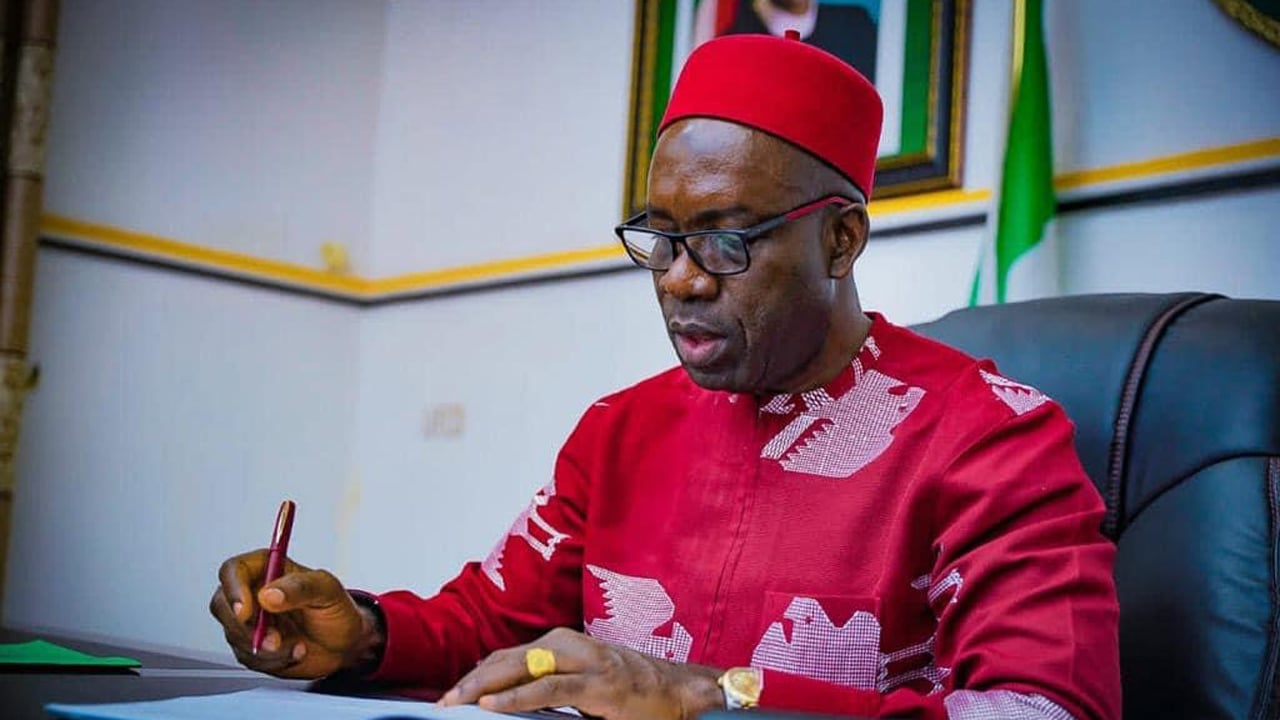

Governor Chukwuma Charles Soludo of the All Progressives Grand Alliance (APGA) has secured a resounding victory in the November 8 Anambra governorship election, extending his hold on the state amid chaos within the major opposition parties — the Labour Party (LP) and the Peoples Democratic Party (PDP).
The Independent National Electoral Commission (INEC) declared Soludo winner after he polled 422,664 votes, far ahead of Prince Nicholas Ukachukwu of the All Progressives Congress (APC), who scored 99,445 votes. The Young Progressives Party (YPP) candidate, Paul Chukwuma, garnered 37,753 votes, while Labour Party’s George Moghalu and ADC’s John Nwosu secured 10,576 and 8,208 votes respectively.
Political observers say the result was no surprise — a product of Soludo’s incumbency advantage, APGA’s deep grassroots reach, and the self-inflicted disarray within the opposition.
Labour Party’s internal war: “We didn’t even know our candidate”
The Labour Party’s internal fractures proved devastating. Factional battles between loyalists of rival national chairmen produced parallel governorship candidates, leaving the party’s base confused and demoralised.
“We were ready to vote Labour, but no one even came here to campaign,” a resident of Nnewi South lamented. “They were fighting themselves while Soludo was busy working.”
The party’s late court interventions came too close to election day, draining campaign funds and focus.
PDP’s decline: Once mighty, now crippled by crisis
The PDP, once dominant in Anambra, continued its downward spiral. Wracked by leadership tussles and mass defections, the party struggled to even field a credible candidate.
When most aspirants shunned the N40 million nomination form due to internal disputes, the party eventually settled for Chief Jude Ezenwafor, a real estate developer, as its flagbearer — the only aspirant left standing.
By election day, the PDP’s machinery was a shadow of its former self, with little visibility at polling units across the state.
Vote-buying allegations taint the polls
Despite warnings from INEC and law enforcement agencies, widespread reports of vote-buying surfaced during the polls.
Witnesses alleged that APGA agents paid between ₦5,000 and ₦10,000 per vote in some areas, while other parties offered as much as ₦30,000.
Labour Party’s candidate, George Moghalu, accused APGA of being the “main culprit,” saying he lost his polling unit because he refused to bribe voters.
“They have too much money to buy votes, and what do you expect my people to do?” he said. “A lot of them are poor.”
Soludo’s incumbency and strategy sealed the win
While opposition parties imploded, Soludo capitalised on his record of governance, touting achievements in infrastructure, education, and economic reforms.
APGA’s well-oiled grassroots structure and tight coordination across the 21 local governments ensured dominance on election day. By the close of collation, Soludo’s landslide was undeniable.
Analysts warn: “Opposition faces repeat disaster in 2027”
Public affairs analyst Nduka Odo of Peaceland University, Enugu, said the election exposed the continued weakness of Nigeria’s opposition.
“The shocking outcome is that PDP, LP, and ADC performed far below expectations,” Odo said. “If they don’t put their houses in order and work together, they’ll face the same humiliation in 2027.”
He added that APGA’s stronghold, nurtured since the Peter Obi era, remains deeply rooted in Anambra’s political landscape.