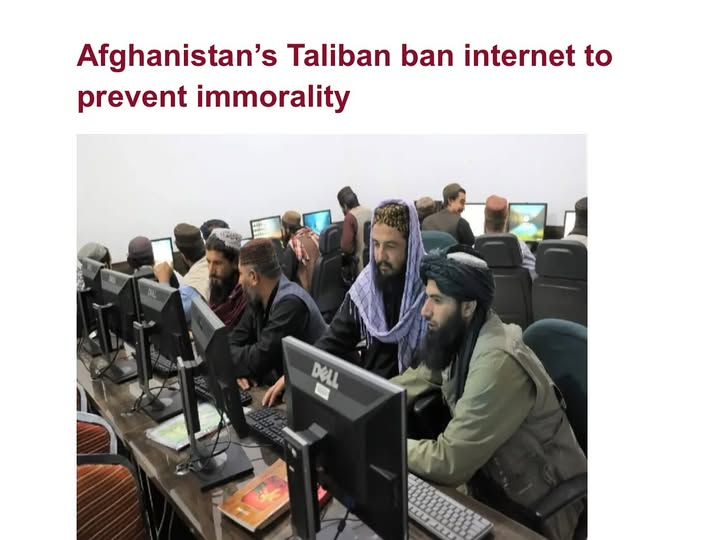

The Taliban has cut off fibre optic internet in Afghanistan’s northern Balkh province, citing the need to “prevent immorality,” in a move that has left homes, businesses, and government offices without Wi-Fi access.
The blackout, ordered by Taliban leader Hibatullah Akhundzada, is the first of its kind since the group returned to power in August 2021. Mobile internet remains available but is often slower, costlier, and less reliable.
Haji Attaullah Zaid, spokesman for the provincial government, confirmed the ban, telling the Associated Press: “This measure was taken to prevent immorality, and an alternative will be built within the country for necessities.” He did not explain why Balkh was singled out or whether similar restrictions would spread to other provinces.
Residents in Mazar-e-Sharif, the provincial capital, said they first noticed connectivity problems several days ago. Many initially assumed the disruption was a technical fault before discovering it was a deliberate shutdown.
One businessman, who spoke anonymously for fear of reprisal, said the ban threatens both education and livelihoods. “Blocking the internet is beyond my comprehension in such an advanced era. My family relies on Wi-Fi for daily life and my student depends on it for classes. Mobile data is slow and expensive. If this continues, I might have to relocate because I cannot afford the loss,” he said.
The ban has sparked alarm over its economic fallout, particularly for businesses reliant on cross-border trade. Local traders warned that severing access to fibre internet risks severing them from international clients.
Afghan authorities have previously suspended mobile networks during religious festivals to curb security threats, such as explosive attacks. But this sweeping ban on fixed-line internet marks an unprecedented step, fuelling fears of tighter information control and restrictions on education and commerce.
Digital rights groups warn that curtailing internet access in Balkh could deepen Afghanistan’s isolation and stifle its already fragile economy.