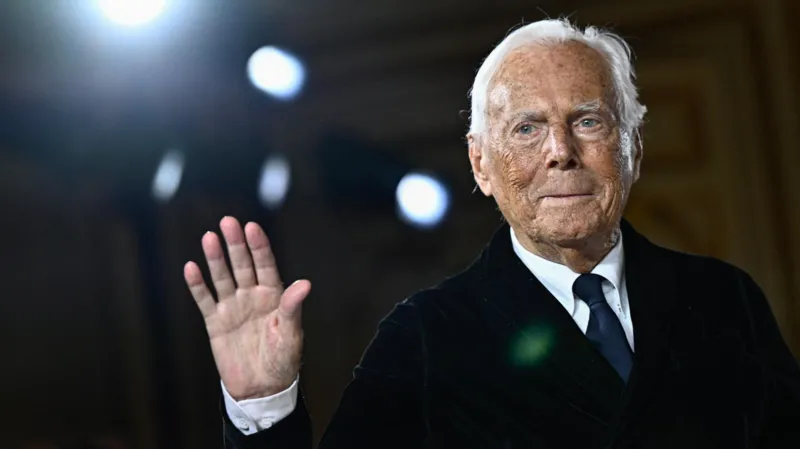

The world of fashion is mourning the death of legendary Italian designer Giorgio Armani, who passed away at the age of 91. The billionaire designer, widely regarded as the epitome of timeless elegance, built an empire that stretched from the catwalk to Hollywood, fragrance, luxury hotels, and even sports. Armani worked until his final days, curating collections and steering his brand with the same relentless passion that defined his six-decade career.
Tributes have poured in from across the globe. Italian Prime Minister Giorgia Meloni hailed him as “an icon and a symbol of the best of Italy,” while Donatella Versace wrote on Instagram: “The world lost a giant today, he made history and will be remembered forever.” Actor Russell Crowe, recalling Armani’s presence at pivotal moments in his life, described him as “a man who made a mark acknowledged around the globe.” Julia Roberts called him “a true friend, a legend,” sharing a photo of them together, while designer Paul Smith praised his independence and resilience in keeping Armani S.p.A. unlisted and privately owned.
Armani’s influence reshaped fashion from the 1970s onward. With his sharp tailoring and minimalist refinement, he revolutionized suits for both men and women, making them symbols of sophistication and power. His designs graced the red carpets of Cannes, Venice, and the Oscars, worn by stars like Zendaya, Cate Blanchett, and Roberts herself. He also dressed performers like Lady Gaga and designed costumes for Hollywood classics, including American Gigolo and The Wolf of Wall Street.
Born in Piacenza in 1934, Armani first pursued medicine before shifting to fashion in the 1960s, eventually founding his label in 1975 alongside Sergio Galeotti, his partner in life and business. Together they built a global powerhouse, generating more than £2 billion annually. Armani’s empire expanded to beauty, fragrance, luxury hotels, and even sport, with ownership of Olimpia Milano basketball club and close ties to Inter Milan.
The designer was also seen as a moral compass in the industry, banning underweight models from his shows in 2006 following the death of model Ana Carolina Reston. His March 2025 collection, unveiled in Paris, carried a political message, with Armani urging the world to “imagine new harmony” amid global conflict. Yet, he faced controversy too—most notably for comments about sexuality in 2015 and tax disputes in 2014, though no wrongdoing was admitted.
Concern over his health surfaced in June 2025 when he missed Milan Fashion Week for the first time in decades. He remotely directed his July couture show in Paris, but those close to him admitted his health had begun to falter. Still, Armani remained “indefatigable to the end,” as his company described him, embodying a relentless curiosity and devotion to his craft.
For millions who admired his work, Giorgio Armani was more than a designer; he was a cultural icon. From his refined silhouettes to his insistence on authenticity, his name became synonymous with elegance itself. As Vogue’s Laura Ingham noted: “Even if you don’t know fashion, you know Armani.” His death marks the end of an era, but his legacy—woven into every stitch of modern style—will endure for generations to come.