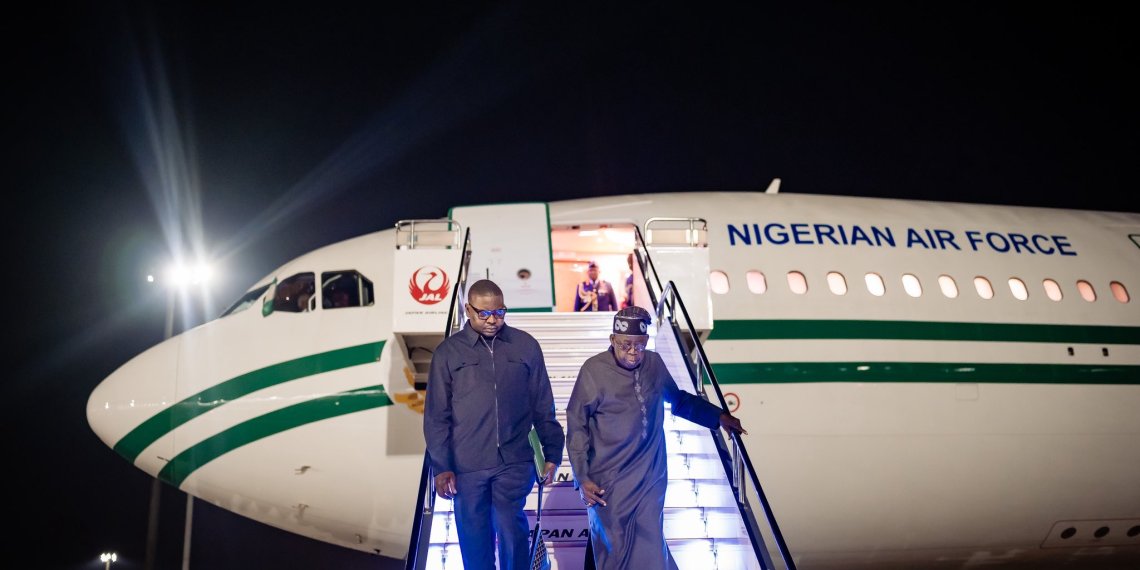

President Bola Ahmed Tinubu touched down in Brasília, Brazil, at 12:30 a.m. local time (4:30 a.m. Nigerian time) on Sunday, August 25, for a two-day state visit aimed at deepening Nigeria–Brazil relations. The visit is expected to redefine bilateral cooperation between Africa’s largest economy and Latin America’s biggest power.
On arrival at Brasília International Airport, Tinubu was welcomed by Brazil’s Secretary for Africa and the Middle East, Carlos José Moreno Garcete, alongside Nigeria’s Minister of State for Foreign Affairs, Bianca Odumegwu-Ojukwu. Top Nigerian officials and Brazil’s Ambassador to Nigeria also formed part of the receiving team, signaling the importance both governments place on this engagement.
The Nigerian leader is scheduled to meet with President Luiz Inácio Lula da Silva on Monday at the Planalto Palace, the official seat of Brazil’s presidency. Talks will cover energy transition, food security, trade expansion, and regional security. Sources in Abuja hinted that Nigeria is particularly keen on leveraging Brazil’s advanced agro-technology to boost domestic food production and reduce heavy import dependence.
Several Memoranda of Understanding (MoUs) will be signed during the visit, covering agriculture, renewable energy, defense cooperation, and cultural exchange. Both leaders are also expected to jointly address a press conference after their closed-door session. This marks Tinubu’s most significant South American engagement since assuming office in May 2023, following earlier trips to the United States, France, and South Africa.
Nigeria and Brazil share a deep historical connection rooted in the transatlantic era, but economic ties have remained underdeveloped. In 2023, bilateral trade volume stood at just $1.5 billion, a sharp contrast to Brazil’s $100 billion annual trade with China. Tinubu’s aides believe this trip could serve as a springboard to reposition Nigeria as Brazil’s strategic partner in West Africa, particularly in oil, gas, and solid minerals.
The visit also comes against a backdrop of global shifts toward South–South cooperation. Lula, a strong advocate of BRICS expansion, has championed deeper ties with Africa. Analysts see Tinubu’s trip as a move to position Nigeria within emerging global economic blocs, while also attracting investment to cushion the impact of Nigeria’s ongoing economic reforms.
Beyond the high-level diplomacy, cultural engagements are also on the agenda. Nigeria’s delegation will meet with Afro-Brazilian communities in Salvador, Bahia — home to one of the largest Black populations outside Africa — to explore cultural diplomacy as a tool of economic and political engagement. This cultural link, dating back centuries, is seen as a powerful soft-power asset Nigeria has yet to fully harness.