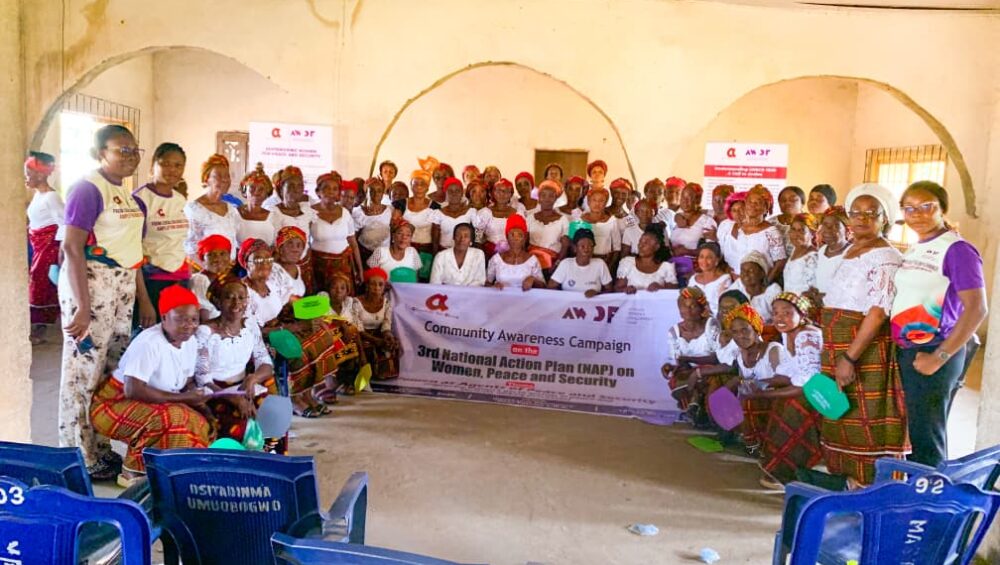

A quiet revolution is underway in Imo State as more than 100 women from Umuokanne community, Ohaji/Egbema LGA, were formally trained on August 18 to serve as community peace and security agents. The training, spearheaded by Alliances for Africa (AfA) with support from the African Women’s Development Fund (AWDF), aims to dismantle decades of exclusion by positioning women at the heart of decision-making, conflict prevention, and community development.
At the core of the programme was the 3rd National Action Plan (NAP 3) on Women, Peace, and Security and the United Nations Security Council Resolution 1325 (UNSCR1325). Participants explored its five pillars, with special focus on establishing conflict early-warning systems that can stop disputes before they erupt into violence. Trainers stressed that empowering women to detect, report, and mediate conflict is no longer optional — it is essential for Imo’s survival.
Community leaders did not mince words about the urgency. Catechist Nwosu, Woman Leader of Umuokanne Autonomous Community, lamented the entrenched subjugation of women and their exclusion from local security councils. She condemned discriminatory practices against widows and young women, calling on men who use tradition as a weapon of oppression to “desist immediately.” Her speech drew resounding applause from participants, many of whom shared similar experiences of exclusion.
For Chinonso Okpara, leader of the Odouka Women’s Meeting, the programme was an awakening. She described it as “an eye-opener” that reinforced women’s worth as equal stakeholders in community security. She pointedly noted how cultural practices that deny women inheritance rights fuel conflict and instability. “Women must unite and dismantle harmful traditions, including the misuse of Umuada structures to silence their voices,” she said.
The training carried symbolic weight, coinciding with Imo’s annual August Women’s Meeting, a period when women across the state gather to deliberate on development. Ahead of the event, the AfA team, led by Project Officer Ms. Ifeoma Obinwa, alongside officials from the Ministry of Women Affairs, paid a courtesy visit to His Royal Majesty, Eze Dr. M.C. Nwokoma, the Okaa-Omee IV of Umuokanne Ancient Kingdom. The monarch praised the initiative, describing it as “timely and vital” to sustaining peace, and pledged his full support.
Ms. Obinwa explained that engaging the traditional ruler was not only to seek royal blessings but also to secure institutional backing for women’s leadership. She called for more community structures to open their doors to women, stressing that without female voices at the table, security interventions would remain incomplete. Her remarks underscored AfA’s broader strategy: to use cultural institutions as entry points for gender inclusion.
The initiative builds on resolutions from an earlier consultative meeting in Owerri where AfA and rural women leaders agreed to leverage the August Meeting as a platform to train “community security agents.” Organisers believe that replicating the Umuokanne model across Imo’s 27 LGAs could transform the state’s security architecture from one dominated by patriarchal politics into a system grounded in inclusivity, accountability, and lasting peace.