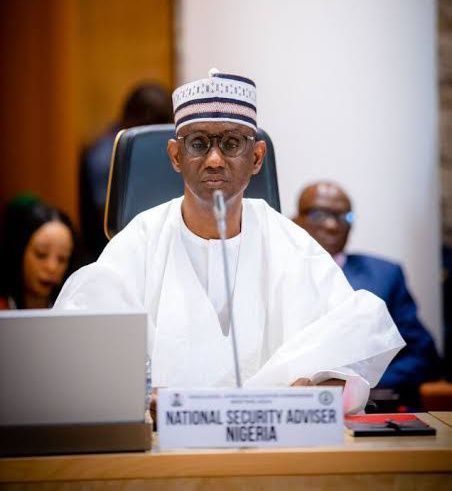

Nigeria’s National Security Adviser, Malam Nuhu Ribadu, has declared that the country has entered a new phase of safety and economic recovery, boldly asserting that citizens can now move freely without fear across all 36 states. His remarks, made during a high-level security briefing in Abuja on July 10, 2025, have sparked intense public debate and media attention.
According to Ribadu, coordinated security interventions across volatile zones have led to a dramatic decline in kidnapping, armed banditry, and rural terrorism. He credited the military and law enforcement agencies for restoring peace to communities once ravaged by violence, particularly in parts of the North-West, North-Central, and South-East regions.
“There is no part of Nigeria you cannot move freely without fear. There is no more kidnapping. Farmers are returning to their farms, businesses are reopening, and clinics are opening up,” Ribadu said. “We have turned the corner. Nigeria is progressing.”
Ribadu’s claims follow a string of recent operations, including the dismantling of major bandit enclaves in Zamfara and Katsina, where over 400 insurgents were neutralized in June 2025 alone. Additionally, security sources report the rescue of over 800 kidnapped persons since the start of the year, with improved air surveillance and local intelligence playing key roles.
The NSA’s declaration is being met with mixed reactions. While some state governors and rural community leaders have echoed the improvements, civil society groups and online commentators argue that pockets of insecurity remain—particularly in remote border towns and flashpoints like Benue, Plateau, and Southern Kaduna.
Ribadu, however, insists that while minor incidents may still occur, the overall trend shows a clear return to normalcy. He urged Nigerians to reject sensationalism and support government efforts by reporting suspicious activity and engaging in community policing.
Analysts view Ribadu’s statement as an attempt to shore up confidence ahead of the 2026 security budget rollout and a potential Tinubu administration re-election campaign. Whether viewed as premature optimism or evidence of real progress, his bold proclamation is forcing Nigerians to reevaluate the narrative on national security.