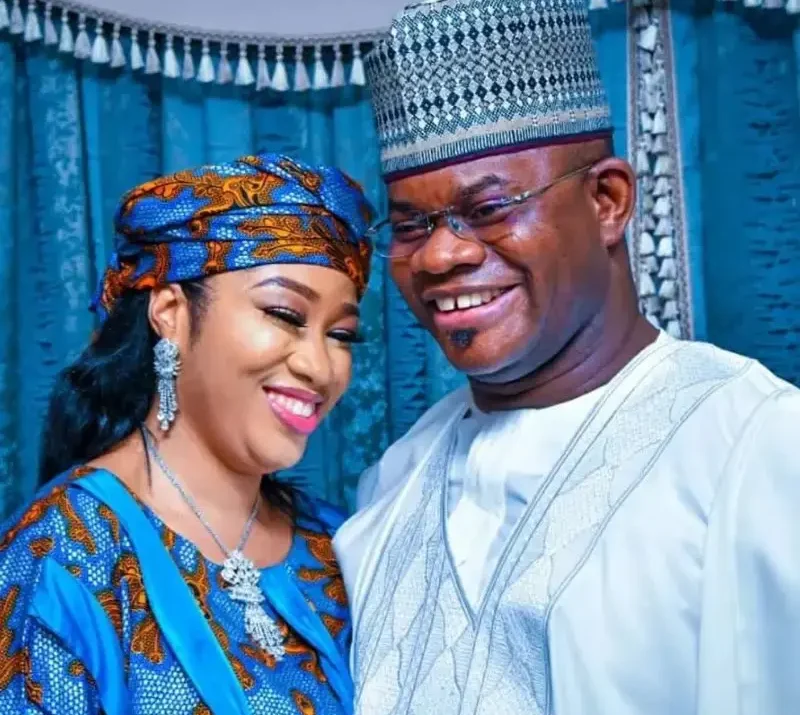

Former Kogi State governor Yahaya Bello has ignited public fury after secretly wedding a fourth wife, Hiqma, in a quiet ceremony held on Saturday, July 13, in Abuja, despite being wanted by the Economic and Financial Crimes Commission (EFCC). The private nikah, attended by a close circle of allies and family members, was revealed by his third wife, Hafiza, via Instagram.
A video from the ceremony shared by Hafiza sparked a firestorm online. “Alhamdulillah, our family just got a little bigger! A warm welcome to our new family member, Mrs. Hiqma Yahaya Bello,” she posted. This move comes at a time when the former governor is facing a ₦80.2 billion corruption case and had previously claimed health issues while seeking to retrieve his seized passport for medical treatment abroad.
Social media exploded with reactions. One user @realkaykerry asked, “I thought EFCC was looking for him?” while another, @tboss_guy, mocked, “Where him get strength to knack new wife?” The former governor’s conspicuous absence from legal proceedings and claims of ill health have left many Nigerians questioning the justice system and governance ethics.
Public frustration deepened as critics pointed out the irony of a man under federal investigation hosting a lavish event. “He no get ‘potassium’ and ‘mild hypertension’ again? Abi this is part of the recommended treatment?” quipped @TheHeroNG, referencing Bello’s court excuses.
Yahaya Bello, who governed Kogi State from 2016 to 2024, already has three wives: Amina Oyiza, Rashida, and Hafiza. He is currently battling allegations of financial misappropriation leveled against him by the EFCC. Despite his denial, authorities declared him wanted earlier this year, fueling the public’s anger when news of his wedding surfaced.
Civil society groups and concerned citizens are calling on anti-graft agencies and the judiciary to explain why a man under investigation continues to evade arrest and live lavishly. Meanwhile, no official comment has come from the EFCC since the wedding video trended.
With trust in political accountability at stake, Nigerians are demanding answers — and action. The question on everyone’s lips: How long will the system look away?