
South-East Leaders Renew Unity Pledge, But Where Is the Roadmap?
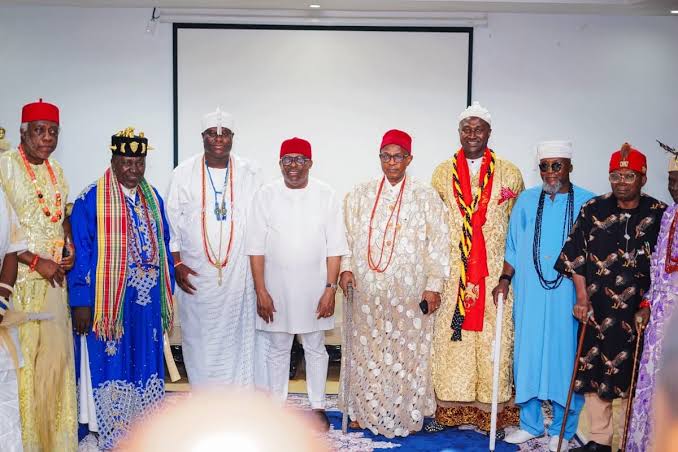
Political, traditional, religious and business leaders from the South-East have renewed calls for regional unity, improved infrastructure and greater political influence, but their latest declaration has raised questions about how the region intends to turn its long-standing demands into concrete results.
At a gathering in Owerri, Imo State, under the South-East Stakeholders Convergence (SESC), prominent Igbo leaders adopted a nine-point communiqué outlining demands that include restructuring Nigeria into six geopolitical zones, securing federal approval for a private seaport in the region, improving rail and gas infrastructure, and adopting a common political position ahead of future presidential elections.
The stakeholders also called for stronger cooperation among South-East governors, an end to public disagreements among political leaders and the establishment of a permanent secretariat to monitor the implementation of their resolutions.
However, the declaration leaves a critical question unanswered: who will take responsibility for delivering these demands, and what accountability measures will apply if the leaders fail to act?
The meeting was convened by Rear Admiral Ebitu Ukiwe (rtd), Senator General Ike Nwachukwu (rtd), Admiral Alison Madueke (rtd), Chief Ozichukwu Chukwu, Chief Gary Igariwey and Professor Uche Azikiwe. Nwachukwu chaired the convergence, which was hosted by Governor Hope Uzodimma at the Banquet Hall of Government House, Owerri.
Uzodimma urged South-East leaders to move beyond what he described as the politics of lamentation and develop a more strategic relationship with the Federal Government.
He called on the region to negotiate its interests directly with President Bola Tinubu’s administration, arguing that greater political influence would require unity, constructive engagement and a willingness to place collective interests above personal ambitions.
“Unite, rethink your political strategies and collectively negotiate the interests of the Southeast with the Federal Government,” the governor said.
He also urged the region’s governors to strengthen their cooperation and support the South-East Development Commission in delivering projects across the zone.
Nwachukwu, a former military governor of old Imo State, identified insecurity, economic hardship, political fragmentation and mutual distrust as challenges weakening the region’s collective strength.
He advocated regional economic integration, industrial development, infrastructure expansion and youth empowerment, insisting that political party differences should not prevent leaders from pursuing shared objectives.
“We are Ndigbo. We are South Easterners. We must move forward with one agenda, one voice and one commitment,” he said.
Nwachukwu also renewed calls for seaports in the region, improved rail and gas infrastructure, and the restructuring of Nigeria into six geopolitical zones, drawing on recommendations of the 2014 National Conference.
He recalled the collective efforts that led to the establishment of the former Imo Airport, now Sam Mbakwe International Cargo Airport, as an example of what regional cooperation could achieve.
However, securing a seaport and delivering other major infrastructure projects would require detailed proposals, federal approvals, financing arrangements, technical assessments and sustained engagement with relevant institutions. A communiqué alone cannot provide these.
Former Governor of old Anambra State, Senator Jim Nwobodo, also urged Igbo leaders to put aside partisan differences. He proposed regular meetings rotated among the South-East states to sustain consultation and encourage wider participation.
Former Senate President Anyim Pius Anyim called for a common strategy in engaging the Federal Government, stressing the need to balance public advocacy with private negotiations.
“We should know when to shout and when to keep silent,” Anyim said.
Former Ohanaeze Ndigbo chairman, Chief Ozichukwu Chukwu, advocated regional economic integration, improved security and youth empowerment. He also called for the release of Nnamdi Kanu, describing him as a “prisoner of conscience”.
“We are not beggars. We are asking for our rights,” he declared.
Dame Josephine Anenih and Professor Osita Ogbu also emphasised the importance of regional unity. Anenih further called for greater inclusion of women in the South-East’s political and development plans.
Former Peoples Democratic Party presidential aspirant and entrepreneur, Mazi Sam Ohuabunwa, highlighted the need for a measurable implementation plan, warning that the resolutions would have limited value without a clear process for achieving them.
The nine-point communiqué was read by former Imo State Governor, Chief Ikedi Ohakim, and adopted following a motion moved by the Deputy Speaker of the House of Representatives, Benjamin Kalu.
Kalu thanked the organisers and Governor Uzodimma for supporting the meeting, reiterating the importance of unity among Igbo leaders and urging the present generation to leave behind values that younger people could inherit.
The convergence also called for a meeting with President Tinubu to present the region’s demands and proposed a permanent secretariat to monitor progress.
The proposal for a secretariat could provide an institutional framework for coordination, but its effectiveness would depend on how it is structured and empowered. The stakeholders would need to identify the institutions and individuals responsible for each resolution, establish timelines, outline funding arrangements and publish regular progress reports.
Without these measures, the latest declaration risks joining a long list of regional political resolutions that generate public attention but deliver little measurable change.
For the South-East, the real test of unity will not be the number of prominent figures gathered in Owerri or the strength of their speeches. It will be whether they can maintain cooperation, hold one another accountable and translate their promises into infrastructure, economic opportunities and improved living conditions for the people they represent.