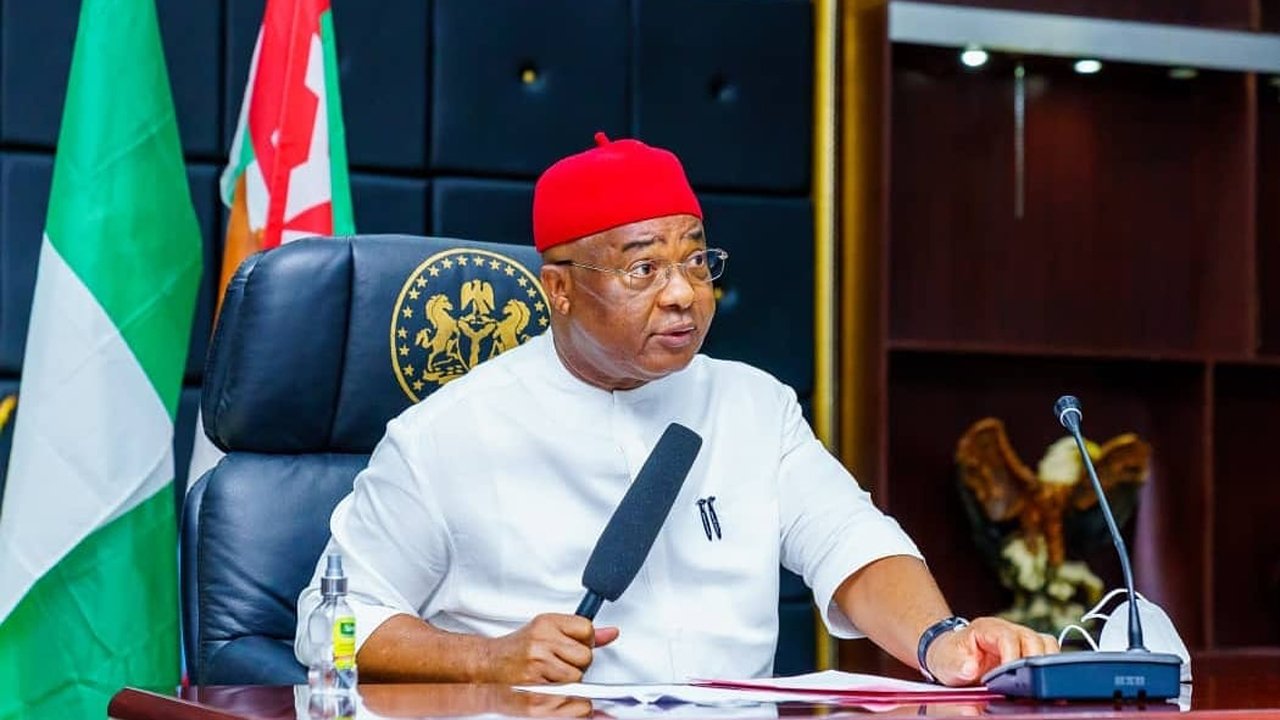
A fresh debate has emerged following the circulation of a viral video showing Imo State Governor Hope Uzodimma struggling to pronounce a word during a lecture delivered at the Federal University of Technology, Owerri (FUTO).
The video, extracted from the university’s June 4, 2026 convocation ceremony, has generated widespread reactions on social media, with critics and political opponents using the clip to question the governor’s public speaking ability.
However, in an opinion article titled “Nobody Is Perfect: Stop Embarrassing Imo State Governor,” media practitioner and public affairs commentator, Chief Emeka Asinugo, argued that the criticism directed at Uzodimma is unfair and fails to consider the broader context of the event.
According to Asinugo, the governor’s difficulty in pronouncing the word “indistinguishable” during a lengthy presentation should not be used to define his personality, competence or leadership.
He maintained that public speaking is a challenging task, particularly when delivering an extended academic lecture before a large audience, noting that even accomplished speakers occasionally stumble over words or lose their flow.
The commentator also pointed out that Uzodimma was speaking before an audience that repeatedly identified him as one of its own, given his status as an alumnus of FUTO. He argued that such expectations can create additional pressure on any speaker.
“Anyone who watched the entire event rather than the carefully selected viral segment would have noticed several important facts,” Asinugo wrote, insisting that the governor successfully delivered the bulk of the lecture despite the isolated moment that has dominated online discussions.
He further argued that criticism of the governor appears to be influenced by broader political sentiments, especially dissatisfaction with the ruling All Progressives Congress (APC), of which Uzodimma is a member.
According to him, while citizens have every right to scrutinize public officials and challenge government policies, personal ridicule over minor mistakes does little to advance democratic discourse.
Asinugo stressed that leaders should be judged primarily on their policies, decisions and performance in office rather than on isolated moments captured on camera.
He also warned against what he described as the growing culture of public humiliation fueled by social media, where short clips are often shared without context, leading to distorted public perceptions.
The article noted that many respected world leaders, academics, lawyers and professionals have made verbal mistakes during public appearances without having their entire careers reduced to those moments.
Concluding his argument, Asinugo said the viral clip simply highlights a universal reality—that no individual is immune from occasional errors.
“The campaign to portray him as a disgrace to Imo State on that basis is therefore unjustified, excessive and intellectually dishonest,” he wrote.
The FUTO convocation clip continues to attract mixed reactions online, with supporters calling for fairness and critics maintaining that public office holders should be prepared for scrutiny in the digital age.