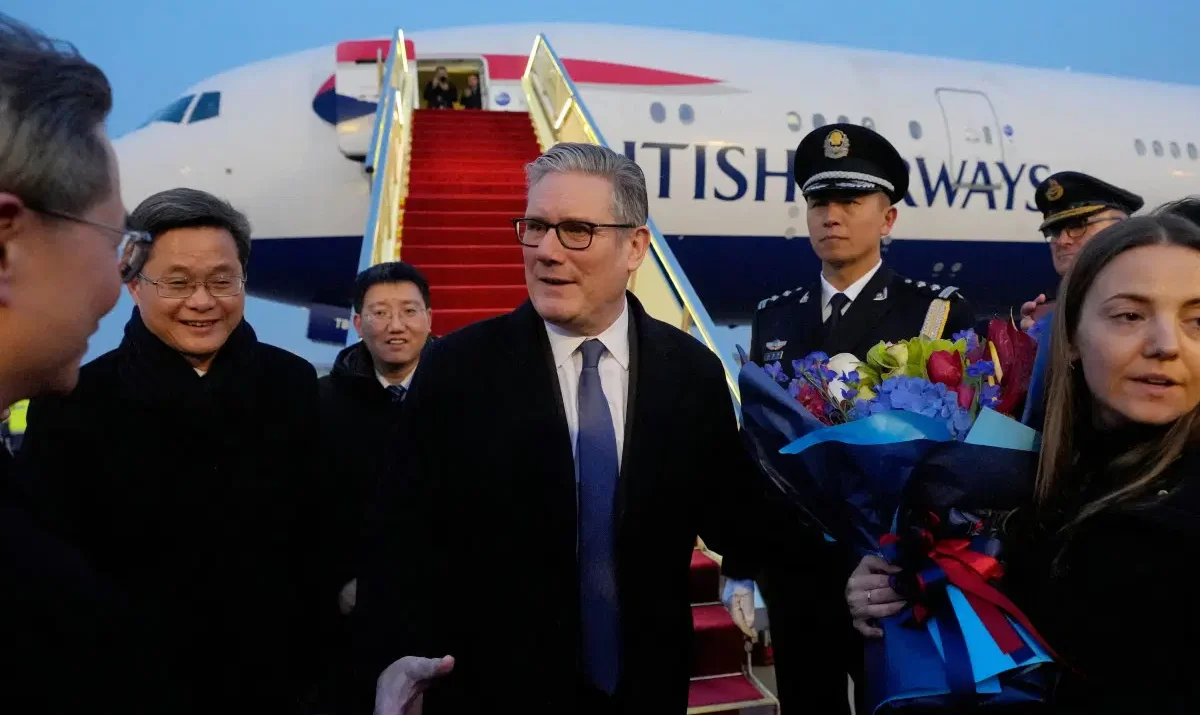

British Prime Minister Keir Starmer landed in Beijing on Wednesday, marking the first visit by a UK leader to China since 2018, in a bid to repair long-strained ties and boost trade, investment, and diplomatic engagement.
Starmer’s visit comes as Western leaders increasingly court Beijing, pivoting from the unpredictable policies of the United States under former President Donald Trump. The UK leader is expected to visit Shanghai on Friday and will later stop in Japan to meet Prime Minister Sanae Takaichi.
Downing Street described the trip as a crucial opportunity to strengthen economic and political relations while addressing sensitive issues such as national security and human rights. Starmer is scheduled to meet with President Xi Jinping for lunch on Thursday, followed by a meeting with Premier Li Qiang.
“This is going to be a really important trip for us,” Starmer told reporters on his flight to Beijing. “There are opportunities to deepen bilateral relations. It doesn’t make sense to bury our heads in the sand when it comes to China. It’s in our interests to engage and not compromise on national security.”
China has also emphasised the visit as a chance to “enhance political mutual trust,” according to Foreign Ministry spokesman Guo Jiakun. Starmer is the latest Western leader hosted by Beijing, following visits by Canadian Prime Minister Mark Carney and French President Emmanuel Macron.
Relations between the UK and China soured in 2020 following Beijing’s imposition of the national security law in Hong Kong, which curtailed freedoms in the former British colony. Tensions escalated with mutual accusations of espionage, including recent claims that China hacked mobile phones of senior UK officials—a report Starmer publicly dismissed, citing robust security measures in place.
Accompanied by around 60 business leaders from sectors including finance, pharmaceuticals, and automobiles, Starmer aims to attract investment while balancing concerns over national security. He also plans to address human rights issues, including the case of Jimmy Lai, a 78-year-old Hong Kong media mogul and British national serving a prison sentence for collusion charges. Starmer indicated he would raise issues “where we disagree” without specifying details.
The visit is seen as a critical moment for Starmer, who faces record-low domestic popularity and hopes the diplomatic engagement can reinforce Britain’s economy and global standing. Controversy has also surrounded the approval of a new Chinese mega-embassy in London, which critics fear could be used for espionage and harassment of dissidents.
Beyond bilateral trade, the UK and China continue to disagree on issues including Beijing’s alignment with Vladimir Putin amid the war in Ukraine and broader human rights concerns, highlighting the delicate balancing act facing Starmer during this high-profile visit.