
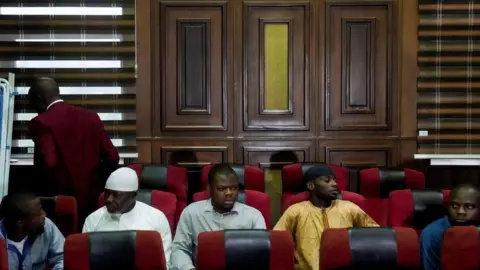
A Federal High Court in Abuja has sentenced four men to death for their roles in the deadly attack on St. Francis Catholic Church in Owo, Ondo State, an incident that left 41 worshippers dead and more than 100 others injured.
The judgment brings a major development in one of Nigeria’s most shocking terror-related cases in recent years. The attack occurred on June 5, 2022, during a Pentecost service, when gunmen stormed the church and opened fire on worshippers, triggering nationwide outrage and grief.
The convicts — Idris Abdulmalik Omeiza, Al Qasim Idris, Jamiu Abdulmalik, and Abdulhaleem Idris — were found guilty on multiple terrorism-related charges, including planning and carrying out the massacre. The court also sentenced them to 20 years imprisonment for membership of a terrorist organisation.
Delivering judgment, Justice Emeka Nwite ruled that the prosecution successfully proved its case beyond reasonable doubt. He noted that the evidence presented against the defendants remained intact throughout the trial and was not undermined during cross-examination.
“The prosecution has established its case beyond reasonable doubt,” the judge said, adding that the defendants were guilty on all nine counts filed against them.
The court heard testimonies from survivors and eyewitnesses who recounted the horror of the attack. Among them was a woman who lost both legs below the knees and her left eye after a dynamite explosion allegedly triggered by the attackers during the assault.
According to prosecutors, witnesses identified some of the convicted men as participants in the attack. The charges against them included terrorism, conspiracy, and mass murder.
Reacting to the judgment, lead prosecutor Ayodeji Adedipe said the verdict delivered justice for victims and their families.
“Justice has been served. Justice has been done to the deceased who were murdered in cold blood,” he said after the ruling.
However, counsel for the convicted men indicated that an appeal would be filed against both the convictions and sentences. During the trial, the defendants alleged they were subjected to torture while in custody, including beatings, suspension from ceilings, and electric shocks. The allegations formed part of their defence arguments.
A fifth defendant, Momoh Otuho Abubakar, was acquitted and discharged after the court found insufficient evidence linking him to the attack. Prosecutors had accused him of financing the operation through funds allegedly received from a suspect still at large.
Abubakar denied the allegations, maintaining that the money traced to his account came from farming activities and cooperative society transactions. The court ultimately ruled that the prosecution failed to establish a direct connection between him and the attack.
Although the four men received death sentences, executions in Nigeria remain rare. Under Nigerian law, presidential approval is required before a death sentence can be carried out, and no execution has been recorded in the country for several years.
The Owo church massacre remains one of the deadliest attacks on a place of worship in Nigeria’s recent history. The incident intensified concerns over insecurity and terrorism, which continue to challenge communities across different parts of the country.