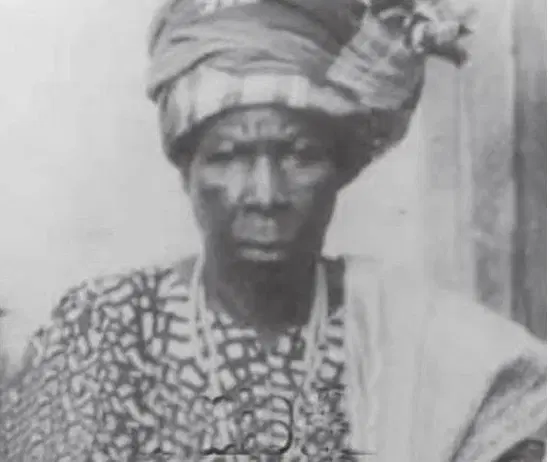

Long before conversations about gender equality and female leadership entered modern African politics, a woman from present-day Enugu State shattered nearly every social rule of her time and became one of the most extraordinary figures in Nigerian history.
Her name was Ahebi Ugbabe — a runaway teenager who escaped ritual sacrifice, survived through prostitution in exile, and later rose to become the first female warrant chief and female king in colonial Nigeria.
Born around 1880 in Umuida, Enugu-Ezike, in what is now Igbo-Eze North Local Government Area of Enugu State, Ahebi grew up in a poor farming household during a period marked by superstition, hardship, and deeply patriarchal traditions.
Her life changed dramatically after repeated family misfortunes led her father to consult a diviner, who reportedly declared that the family’s suffering was caused by the anger of a female deity known as Ohe.
To appease the deity, Ahebi was to be dedicated through a traditional ritual marriage known as Igo ma ogo — a fate that would have effectively turned her into a sacred outcast.
But Ahebi refused.
Still a teenager, she fled her community and travelled to Igalaland in present-day Kogi State, where survival forced her into life on the margins of society.
Without family protection or social standing, she became a commercial sex worker. Yet those difficult years would unexpectedly become the foundation of her rise to power.
While living in exile, Ahebi learned several languages, including Igala, Nupe, and Pidgin English, and built connections with traders, local elites, and later British colonial officials moving into the region.
Her relationship with influential figures, including the Attah-Igala, positioned her as an important intermediary at a time when British colonial forces struggled with local communication and territorial expansion.
When British troops advanced into Enugu-Ezike, Ahebi reportedly assisted them as a guide and interpreter. In return, colonial authorities rewarded her with political influence and later appointed her a Warrant Chief — an unprecedented position for a woman in Igbo society at the time.
By the mid-1920s, Ahebi had fully transformed from exile to monarch.
Backed by colonial administrators and local political alliances, she became the first female Eze, or king, in colonial Nigeria, openly occupying a role traditionally reserved for men.
She adopted royal regalia, performed male kingship rituals, and even took multiple wives — another privilege culturally restricted to male rulers.
Children born within her household reportedly carried her name, reinforcing her authority and lineage in ways that challenged conventional gender structures in Igbo society.
Historians later described Ahebi’s identity as an example of “female masculinity,” reflecting how some pre-colonial African societies allowed more fluid interpretations of gender and power before European colonialism imposed stricter binaries.
Her reign, however, was not without resistance.
Controversy erupted after she allegedly attempted to participate in the sacred Ekpe masquerade institution, an area considered exclusively male. Many traditionalists viewed the move as crossing a boundary too far, even for a king.
Despite opposition, Ahebi remained influential for decades, navigating both indigenous politics and British colonial interests with unusual skill.
Historian Nwando Achebe famously described her as “a runaway, a sex worker, a headman, a warrant chief, and eventually a female king.”
Ahebi Ugbabe died in 1948 after a reign that permanently altered conversations around leadership, gender, and identity in southeastern Nigeria.
Even in death, she broke convention once again.
She was buried with the honours and rites reserved exclusively for male kings — a final recognition of the extraordinary identity and authority she had carved out in a society that once tried to erase her future entirely.