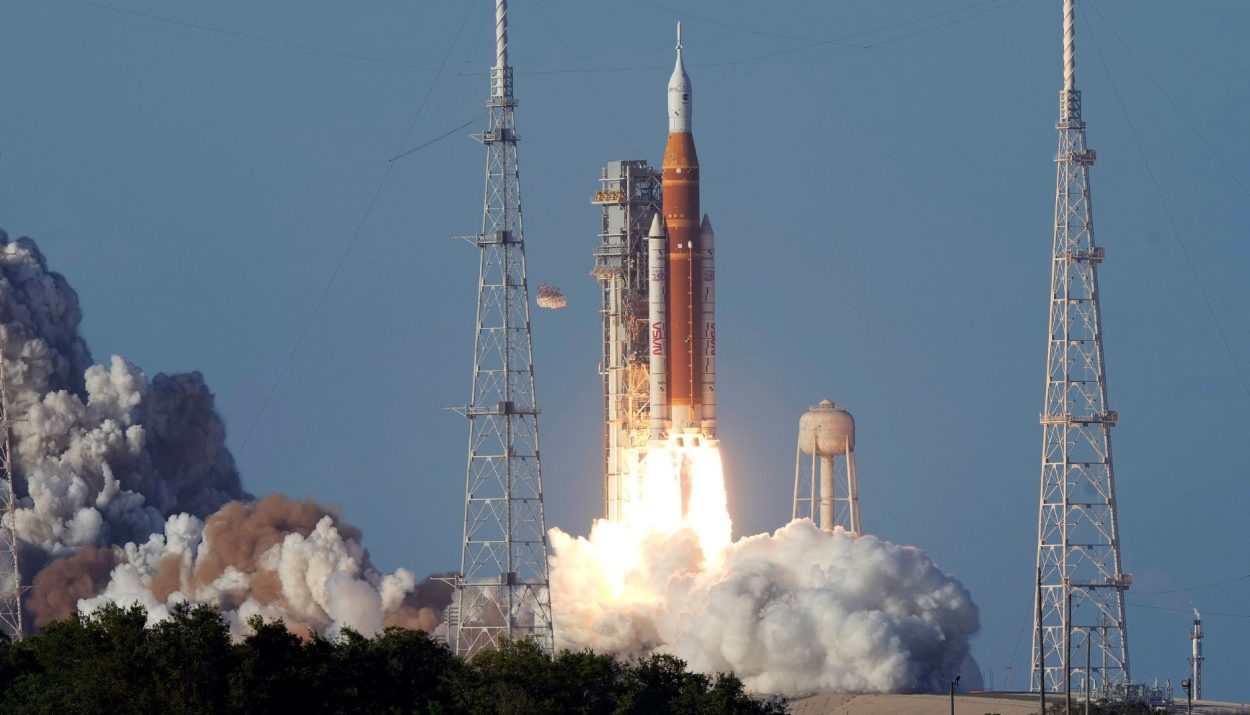

Nasa’s Artemis II mission has finally lifted off, marking a pivotal moment in the United States’ bid to reclaim leadership in the global space race. The four-astronaut crew Commander Reid Wiseman, Victor Glover, Christina Koch, and Jeremy Hansen are now orbiting Earth roughly 42,500 miles above, conducting vital tests on the Orion spacecraft.
The mission is historic: Orion has never before carried humans into space, and Nasa is meticulously evaluating its performance before the crew ventures into deep space, where no immediate rescue is possible. The spacecraft’s solar wings deployed successfully soon after launch, providing power for the journey ahead.
Astronauts aboard Orion are following strict routines. Eight hours after launch, the crew took their first rest periods, with Commander Wiseman humorously asking mission control for “comfort garments” before settling into the specially designed hanging sleeping bags. Over 24 hours, the crew sleep in two four-hour blocks to maintain peak alertness.
Exercise is mandatory to counteract the effects of weightlessness on muscles and bones. Reid Wiseman and Victor Glover tested Orion’s compact “flywheel exercise device,” performing rowing motions, squats, and deadlifts. Christina Koch and Jeremy Hansen were scheduled for their session later in the day.
Meals aboard Orion are freeze-dried and activated with water from an onboard tap. The crew selected menu items in advance, enjoying dishes like macaroni cheese and beef brisket, accompanied by hot sauces of their choice. For drinks, they are limited to two daily, including coffee or a “chocolate breakfast drink.”
Early concerns over Orion’s onboard toilet were quickly resolved. After a minor malfunction during launch, Christina Koch received guidance from Mission Control, which confirmed: “Happy to report that toilet is go for use… We do recommend letting the system get to operating speed before donating fluid.”
The mission now builds toward the trans-lunar injection (TLI) burn, a crucial maneuver designed to propel Orion out of Earth’s orbit and on a trajectory toward the Moon. Scheduled for Thursday night UK time, the burn will last approximately six minutes and leverage lunar gravity to slingshot the spacecraft around the Moon before returning to Earth.
If successful, Artemis II will carry the astronauts 6,400 miles (10,299km) beyond the Moon’s far side—the first humans to view this region directly, though it has been photographed by probes from India, China, and other nations. The crew will capture images and conduct observations, providing a rare glimpse of the lunar surface for scientists and the public on Earth.
A Nasa official confirmed that the crew is “safe, secure, and in great spirits,” as anticipation builds for what could be a landmark step toward returning humans to the Moon by 2028.