
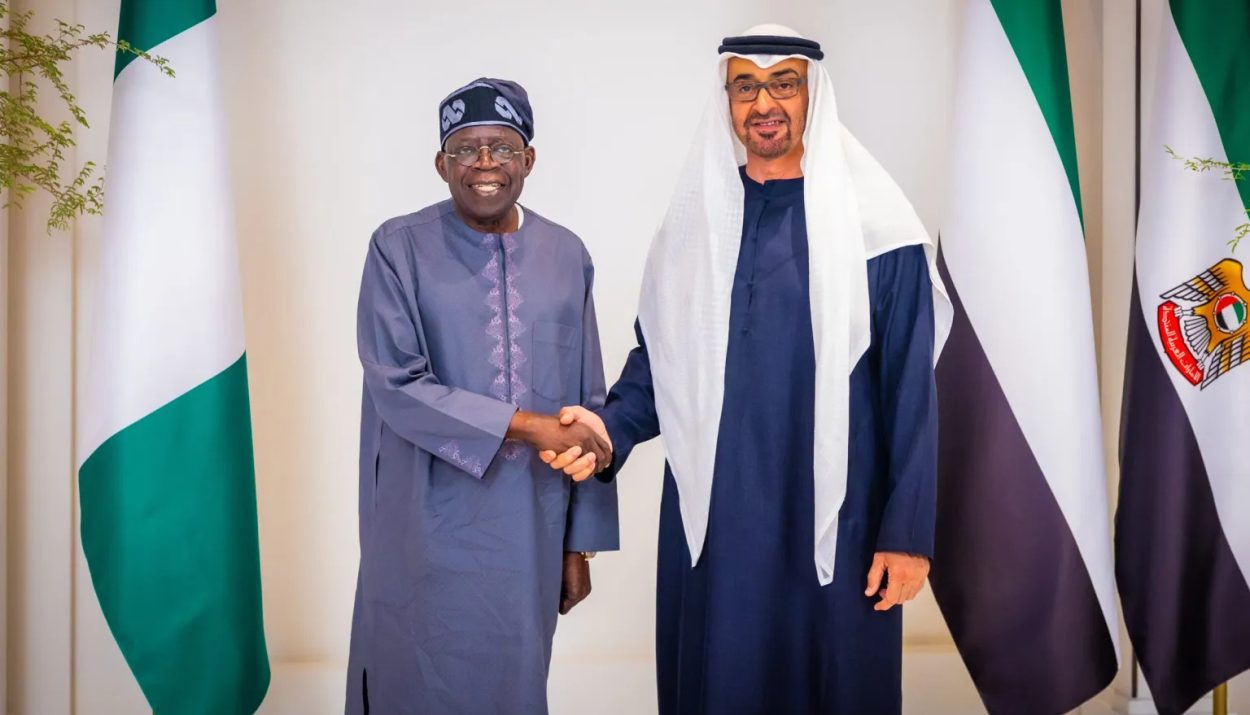
A viral claim comparing Nigeria’s economy with that of the United Arab Emirates (UAE) has sparked heated debate online, with many users blaming Nigeria’s economic struggles on poor leadership. However, key figures used in the comparison are inaccurate.
The post, shared on X, claimed that Nigeria discovered oil in 1956 while the UAE made its first discovery in 1958, adding that the UAE is now “worth $700 billion” whereas Nigeria is “$500 billion in debt.” Although the oil discovery dates are correct, independent verification shows the financial figures are misleading.
Records from Nigeria’s Federal Ministry of Petroleum Resources confirm that Shell-BP discovered commercial oil at Oloibiri, now in Bayelsa State, in 1956. The Abu Dhabi National Oil Company (ADNOC) also confirms that the UAE’s first commercial oil discovery was made in 1958 at the Murban Bab oil field, two years after Nigeria’s.
The biggest flaw in the claim lies in Nigeria’s debt figure. According to the Debt Management Office (DMO), Nigeria’s total public debt stood at $110.97 billion (N159.28 trillion) as of December 31, 2025. This includes both domestic and external debt owed by the Federal Government, the 36 states and the Federal Capital Territory. The widely shared claim of $500 billion debt is therefore false.
The claim about the UAE’s wealth is also inaccurate. Data published by the Boston Consulting Group (BCG) and reported by Gulf News shows the UAE’s total net wealth reached approximately $3.12 trillion by the end of 2025, consisting of about $1.15 trillion in financial assets and $2.18 trillion in real assets. The $700 billion figure referenced online appears to relate to specific private wealth and investment metrics rather than the country’s overall net wealth.
Economists also argue that the comparison itself is fundamentally flawed because it measures two completely different indicators. Comparing Nigeria’s public debt with the UAE’s net wealth does not provide a fair assessment of either country’s economic position.
Chief Economist at SPM Professionals, Paul Alaje, explained that public debt should be analysed alongside government revenue, debt servicing obligations and foreign reserves. He noted that countries such as the United States and China carry significantly larger debts than Nigeria while maintaining stronger economies, showing that debt figures alone do not determine economic performance.
Former Director-General of the Lagos Chamber of Commerce and Industry and Chief Executive Officer of the Centre for the Promotion of Private Enterprise (CPPE), Muda Yusuf, also dismissed the comparison. He said differences in governance, policy consistency, investment climate and management of oil resources—not merely the timing of oil discoveries—largely explain the contrasting economic fortunes of Nigeria and the UAE.
While the viral post correctly states that Nigeria discovered commercial oil before the UAE, its claims about Nigeria’s debt and the UAE’s wealth are inaccurate. The comparison also mixes unrelated economic indicators, making its conclusion misleading.