
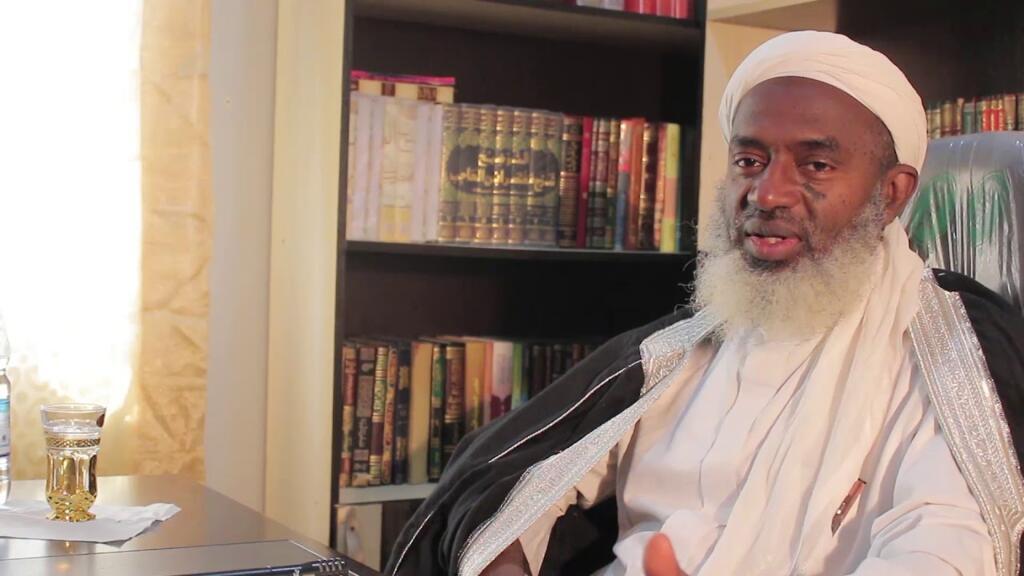

Prominent Islamic cleric Sheikh Ahmad Abubakar Mahmoud Gumi has rejected allegations linking him to support for banditry, insisting that his repeated calls for dialogue and rehabilitation have been misrepresented by critics and online commentators.
Speaking in Kaduna, Gumi defended his position on insecurity in Northern Nigeria, arguing that the country’s heavy reliance on military force over the years has failed to end banditry and insurgency.
According to the cleric, Nigeria has largely pursued a kinetic approach since the death of Boko Haram founder Mohammed Yusuf in 2009, yet violent attacks have continued to spread across several northern states including Zamfara, Katsina and Niger.
“If the kinetic approach is not working for 17 years, why don’t you change the approach? Why don’t you change the methodology?” Gumi asked.
The cleric maintained that previous interventions in some states focused mainly on paying off armed groups without addressing the deeper social and economic conditions fuelling the violence.
He advocated a broader peace and rehabilitation framework that would involve engaging armed groups, encouraging disarmament, removing them from forest camps and providing education opportunities for their children.
“These people told us they are ready to lay down their arms, but what are their conditions? Has anybody listened to them?” he queried.
Gumi said many bandits fear arrest, revenge attacks or execution after surrendering, stressing that confidence-building measures would be necessary for any meaningful peace process.
Drawing comparisons with the government’s rehabilitation programme for repentant Boko Haram members, the cleric argued that a similar strategy could produce better results in tackling banditry.
“From the number of Boko Haram repentants, which are in thousands, you can see that the same approach can be applied to the bandits,” he stated.
Beyond security, Gumi also criticised corruption and poor governance, insisting that criminality should not be excused whether committed by armed groups or public officials.
“We need sanity in governance,” he said. “We don’t want to hear stories of government officials swallowing billions of naira while talking about fighting criminals. Crime is crime.”
In a separate statement issued on May 23, 2026, the cleric strongly denied ever supporting terrorism or banditry, saying false narratives about him were being spread deliberately.
“I hereby state unequivocally that any video clip, written statement, or message attributed to me — whether directly or by innuendo — suggesting support for, justification of, protection of, or advocacy for banditry or terrorism in Nigeria or anywhere else does not emanate from me,” the statement read.
Gumi accused what he described as “ethnic-interest groups” and sensational online content creators of distorting his views, while warning that legal action could be taken against those circulating fake or manipulated materials about him.
He also expressed hope that Nigeria would eventually overcome insecurity by addressing poverty, social injustice and lack of education, which he described as major drivers of violence and extremism.