
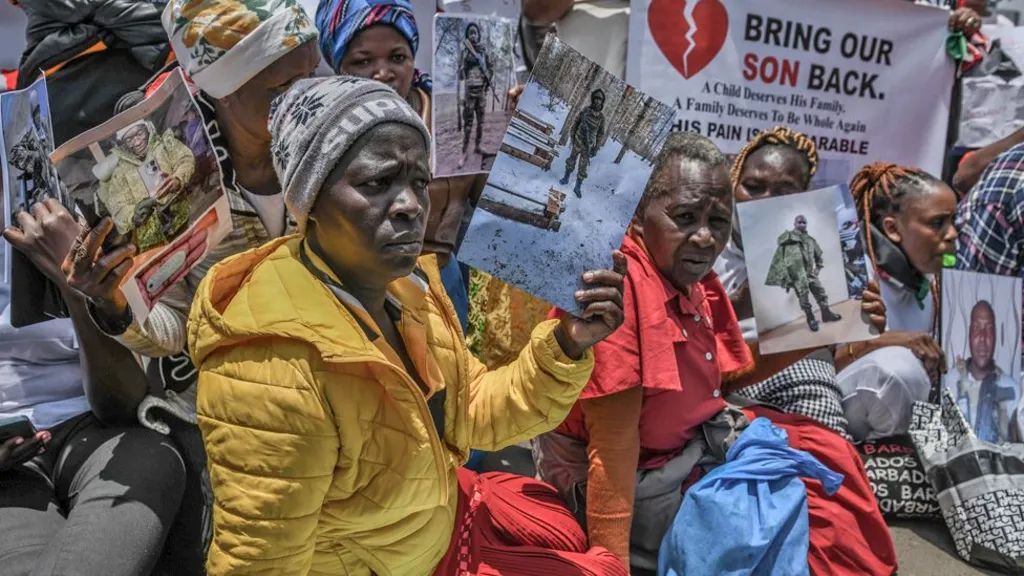
Kenya is facing a growing crisis as more of its citizens vanish into the fog of war in Ukraine, with at least 16 now officially listed as missing after joining Russia’s military.
The alarming update was confirmed by Foreign Affairs Minister Musalia Mudavadi, who told lawmakers that the number of missing Kenyans had risen sharply within 24 hours, raising fresh fears about their fate.
The situation goes beyond those unaccounted for. According to the government, 38 Kenyans are currently in Russian hospitals under restricted access, while 47 others have already returned home from the front lines.
In total, officials estimate that more than 250 Kenyans have been drawn into the conflict since it began, with about 165 still actively involved in military operations.
For many, the path into the war did not begin with ideology—but with opportunity.
Mudavadi revealed that most recruits signed up voluntarily, attracted by promises of high-paying jobs, monthly salaries of up to $2,700, and even the possibility of Russian citizenship. Initial enlistment bonuses reportedly ranged between $11,500 and $23,000.
But what looked like a financial escape route has, for some families, turned into a nightmare.
Authorities say a network of recruitment agencies operating across Kenya, Russia, Qatar, and the United Arab Emirates played a key role in facilitating enlistment—often blurring the line between legitimate employment and dangerous deception.
The Kenyan government has since launched a crackdown, shutting down more than 600 suspected recruitment agencies and opening investigations into illegal enlistment practices.
Diplomatic efforts are also underway. Mudavadi recently met with Russia’s Foreign Minister Sergei Lavrov, with both countries agreeing to halt the recruitment of Kenyan nationals into the Russian army.
Despite that agreement, the human cost continues to unfold.
Two Kenyans are currently being held by Ukraine as prisoners of war, while the fate of the missing remains uncertain—leaving families in limbo, unsure whether their loved ones are alive or dead.
The issue is not isolated to Kenya. Ukrainian intelligence estimates that more than 1,700 Africans from 36 countries have been recruited into the conflict, highlighting a wider trend of foreign enlistment driven by economic hardship and global recruitment networks.
For Kenya, however, the crisis has become deeply personal.
Behind every statistic is a family waiting for answers—and increasingly, running out of hope.